
Wednesday, 16 September 2026
A Song That Waited 35 Years: The Beautiful, Unfinished Life of Sudhir
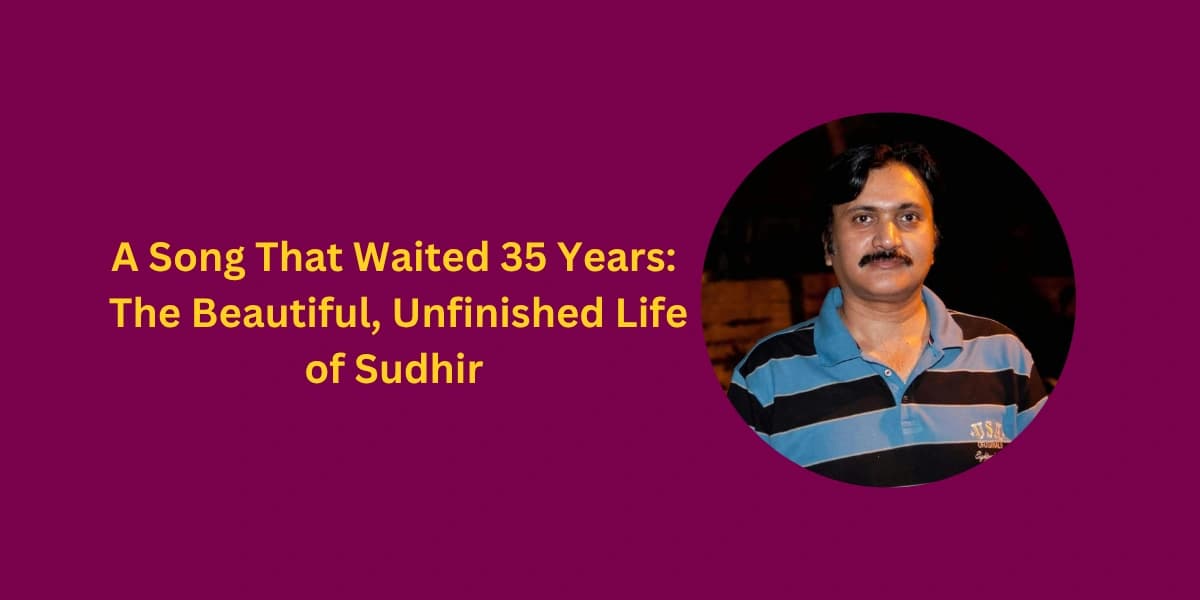
In a quiet home near Bangalore's Double Road, mornings begin at five. There is fire to light, food to cook, a small puja to complete, and then, before the world fully wakes, an hour and a half spent with music. This is how Sudhir, a 53-year-old senior accounts executive and one of Marzi's most soulful members, begins nearly every day of his life. It is a routine built on discipline, but it is also something quieter and more moving: a promise kept to a boy who once had to put his music away.
Sudhir was born in the 1970s in Bangalore's Narasimharaja Colony, a close-knit, traditional Brahmin neighborhood where community and culture ran through everything. His schooling took him through Mahila Mandali School, then St. Joseph's High School in City Market, and later Vijaya PU College in Southend Circle, each stage, in his words, "a different phase of life," with different friends and different textures of experience. When it came time for a degree, Sudhir chose the harder road: a correspondence course, completed entirely on his own while he was already working, first at a chartered accountant's office, then with a sales tax practitioner. It was an education built between jobs, in stolen hours, the way many meaningful things in his life would come to be built.
Even as a child, Sudhir was pulled toward music and toward art. He sang in music classes near home and, later, found his way into painting and sketching, drawn especially to landscapes. At the Indian Institute of World Culture, he studied briefly under a gifted fine artist whose lively, luminous paintings left a lasting impression on him. But of all his early loves, singing ran deepest, and it was singing that he had to set aside.
His father, worried that music might distract a young man from securing his education and his future, gently postponed his formal classical training to a later stage. It was not resentment that Sudhir carries from this, but understanding, the ordinary, protective anxiety of a parent for a child's stability. So the music waited. Sudhir built his career, working steadily as an accountant, eventually settling into his current role, where he has spent the last six years as a senior accounts executive at a manufacturing company.
Then, after 35 years, he returned to it.
Today, Sudhir has been in classical vocal music for the past sixteen years and has played the sitar for twelve. He is now in his advanced stages of learning. His lineage of teachers reads like a quiet piece of Karnataka's musical history: his vocal guru is the nephew of the legendary violinist after whom Bangalore's Chowdiah Memorial Hall is named, and his sitar guru is Ustad Hafiz Khan of Dharwad, a custodian of a tradition passed down across seven generations. And beneath both disciplines lies the earliest influence of all: his mother, who filled their home with devotional songs, and whose voice, Sudhir believes, lives on in his own. "Whatever I am today," he says simply, "it's because of her."
Ask Sudhir about inspiration, and he doesn't reach for grand abstractions, he reaches for people who struggled and kept going anyway. In 2003, he had the chance to sing before the legendary playback singer Dr. S. P. Bala Subrahmanyam, an experience he still describes as one of the defining moments of his life. What moves him most about his idol isn't fame, but effort, the discipline of a man who, even after achieving greatness, worked relentlessly. "When those people have done so much," Sudhir says, "why can't we?" It's a question he seems to ask himself often, especially on the evenings when practice feels hard and his mind resists sitting still.
Sudhir found Marzi almost by accident, through a reel that mentioned a contest built specifically for people aged fifty and above. His first reaction was surprise, then quiet delight: a platform that celebrated people like him. He auditioned, nerves and all, and found his way in. Since then, Marzi has become part of the rhythm of his life, even if work and rigorous music practice limit how often he can attend events in person. One memory stays with him vividly: arriving at a pre-event gathering ahead of Marzi's 2025 finale and meeting members in their sixties and beyond, radiating more energy than he felt he had himself. Around the same time, he came across a 90-year-old gynaecologist still practicing medicine, living proof, to him, that vitality has nothing to do with the number of years behind you. "It's just a number," he says. "As long as your breath is there, you can do anything."
That belief shapes how Sudhir thinks about aging and retirement altogether. A career may end, he says, but passion doesn't retire, not as long as health and enthusiasm remain. His days are full: eight or nine hours at the office, music practice before and after, occasional karaoke evenings, and attending his gurus' performances whenever he can, because every note learned from them, he believes, becomes part of his own future.
Life, in Sudhir's own words, is "an ongoing, beautiful thing" shaped entirely by how you choose to carry it. He speaks this not as a comfortable philosophy but as something hard-won. He lost his mother less than a year ago, and the months since have been, in his words, genuinely difficult, difficult enough to nearly extinguish the desire to pursue the things he loves. But he chose otherwise. "God has given me life," he says. "As long as I'm alive, I have to take it." If you can't achieve something, he adds, then at least stay calm, and stay happy. That, too, counts as a life well lived.
Sudhir's story is not one of overnight discovery, but of patient devotion, a 35-year wait that never curdled into regret, and a belief, quietly held and daily practiced, that as long as there is breath, there is still song left to sing.