
Thursday, 30 July 2026
“Let Difficulty Know That I Am Difficult”: The Story of Mimi
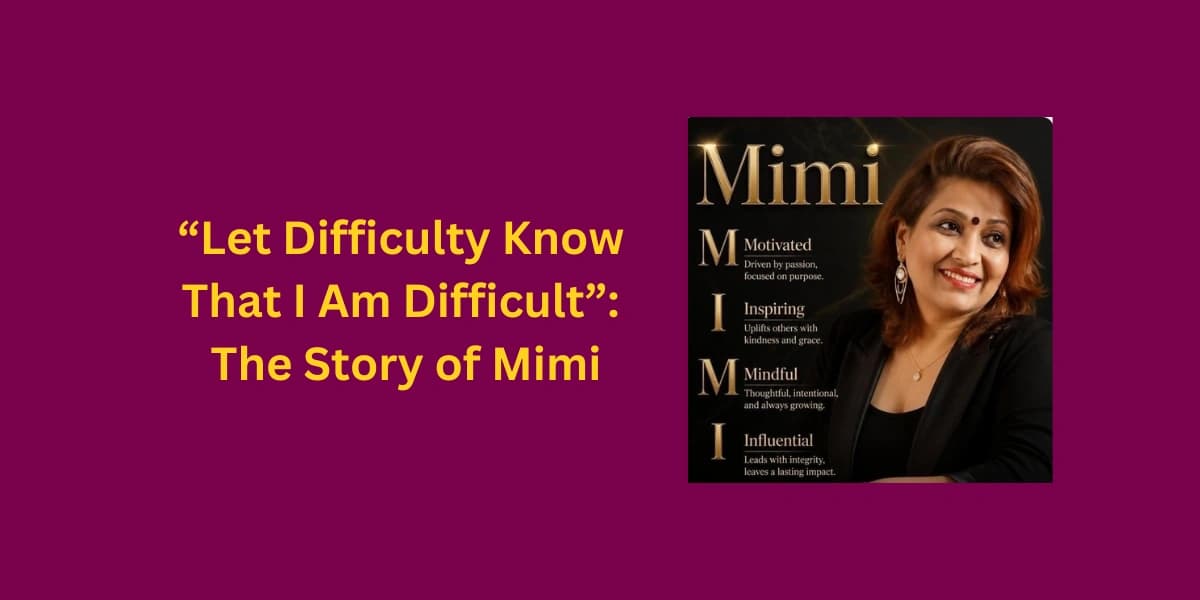
Turning Adversity into a Life of Purpose
There is a sentence Mimi likes to repeat, one she has clearly turned over in her mind many times, until it came out polished: "Let difficulty know that I am difficult." It is a small twist of words, but it holds the whole shape of her life. Difficulty came for her early and often. She simply refused to let it define her.
Mimi's childhood, by her own account, was everything a childhood should be - warm, loved, remarkable in the best sense of the word. She grew up in West Bengal with parents who cherished her and a sister she adored. In 2005, she married a Bengali man in an arranged match. She was a schoolteacher then, standing in front of classrooms, her legs carrying her through ordinary days that she had no reason to think were numbered.
A year into the marriage, everything changed. Mimi was diagnosed with Ankylosing Spondylitis: a severe chronic autoimmune condition she had never even heard the name of before it took hold of her body. Within months she could no longer stand, let alone teach. She was admitted to a hospital in Bangalore - the city that, decades later, she still calls home, and for six months she was bedridden, unable to walk, unsure whether she ever would again.
It is easy, in hindsight, to compress six months into a single sentence. It is harder to sit with what those months actually were: her mother and sister at her bedside, her brother-in-law ferrying her to endless rounds of steroids and injections, doctors debating a hip replacement but holding off because of her age, a specialist traveling all the way from Calcutta to monitor her case. And underneath all of it, a silence from the people who should have been closest, her husband and in-laws kept their distance for the better part of those six months, unwilling, in her words, to stay linked to her uncertainty. That isolation, more than the disease itself, is what pulled her toward depression. She was convinced, she says plainly, that this was going to be the end of her life.
What pulled her back was not a single dramatic turn but a quiet, daily discipline of faith. She was given a copy of the Satcharita of Shirdi Sai Baba and read from it every day, never missing a single one, even when she had no idea what the next day would bring. Slowly, first with a walker, then without, she began to walk again.
Her mother didn't want the marriage to end, so Mimi gave it another chance, returning to Bangalore with her husband. But trust, once broken by absence during someone's darkest months, doesn't rebuild itself overnight. It took years. The real turning point came, unexpectedly, through Sri Sri Ravi Shankar's Art of Living community, where she learned Sudarshan Kriya, a breathing-based practice she describes as nothing short of a miracle for a body and confidence that had once felt entirely paralyzed. Her teachers seeing what she'd survived, began entrusting her with real responsibility, as a youth leader, and eventually as the person coordinating a tree-planting drive across Karnataka, negotiating with local legislators despite not speaking the local language. In one month, her team planted a thousand trees, work significant enough to draw media coverage.
Something shifted in her during that work. She stopped thinking about her own pain long enough to think about the world instead, and in that shift, she found she had healed a little more than she realized. Her husband, watching her rebuild herself and reach outward instead of inward, began to reckon with his own part in those difficult early years. He stayed by her side through two more hip replacements, in 2010 and 2024, regardless of whether his family chose to be present or not.
A senior Art of Living teacher almost took up her case as a challenge. She taught her Mudra Healing, ways to distress and move on in life with positivity. A friend cum yoga trainer from Yogavriksh, without charging a penny, took training and made diet charts to make her move out of her aches to wellness.
When her limbs didn't move and she was held in a cot for hours together with traction, her cousin, came all the way from her house to her, almost every day to feed her every single day.
Mimi doesn't have biological children, after ten to fifteen years of corticosteroid treatment necessary to keep her walking, her doctor gently steered her away from that risk. When her sister passed away during the pandemic, Mimi took on the raising of her nephew as her own, formalized through a traditional thread ceremony that made her, in every way that matters, his mother. He's studying engineering now.
Today, at fifty, Mimi's days begin before dawn with meditation and Sudarshan Kriya, what she calls "the mental and dental hygiene" of her mornings, non-negotiable before anything else begins. She works from home as a content writer, cares for her aging mother, who carries her own grief for the daughter she lost, and finds joy where she always has: in music. It was a singing event, discovered through Facebook, that first brought her to Marzi, a community she now treasures for the same reason she has come to treasure Art of Living, because it turns her outward, towards people, towards laughter, towards song, rather than inward, towards pain. In Pune, she was crowned a finalist in the Mrs. Porichiti pageant, one more small, joyful marker in a life that refused, again and again, to be defined by its hardest chapters.
Mimi is candid that her illness is not cured, only managed, she is not, in her words, "done and dusted." But she has stopped waiting for a finish line. There is still a thousand trees' worth of work she wants to do in the world, still a paradigm she wants to keep shifting from herself to others. Difficulty came for her early. She simply decided, again and again, to be difficult in return.