
Tuesday, 28 July 2026
The Boy from Palakkad Who Never Stopped Moving Forward
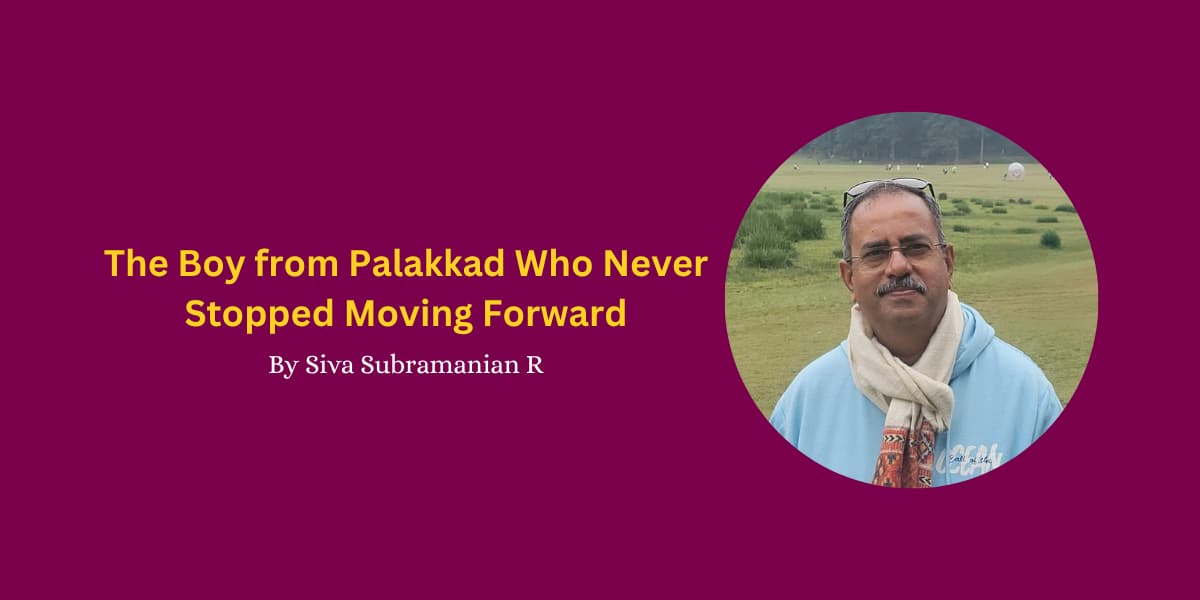
A Life Shaped by Simplicity, Change, and Perseverance
There is a particular kind of quiet that belongs only to small Indian towns before the internet arrived, the quiet of a cricket ground at dusk, a river close enough to jump into after the last over, and a single black-and-white television flickering to life at eight o'clock sharp. It is in that quiet that Sivasubramanian R's story begins.
Born in Tamil Nadu and raised in Palakkad, a modest town in Kerala known for its temples and its tight-knit Brahmin villages, Sivasubramanian grew up in a world that asked for very little and gave, in return, something far more valuable. "No mobiles, nothing," he says of those years, almost fondly. Evenings meant cricket on a ground beside the river, a dip in the water when the game was done, and then home for a few hours of study before the ritual of the day - Doordarshan, the only channel available, watched under the shadow of the long antennas that every rooftop in the neighbourhood seemed to carry like a flag. "That's, you know, pretty nice childhood," he reflects, "something we can always cherish and love." It was a life built entirely around friends, games, and the occasional exam-time scramble to study, uncluttered by the distractions that would come to define the decades ahead.
College life continued in the same unhurried rhythm, a bicycle ride to classes that wrapped up by early afternoon, science subjects that demanded focus rather than frenzy. But underneath that gentleness ran a current of real pressure. Engineering seats in Kerala at the time were staggeringly scarce, the cutoff hovering somewhere around rank 2,000, a number that seems almost impossible to imagine today, when opportunity feels so much more abundant. Sivasubramanian didn't make the cut for engineering. Instead, he found his way into something newer, less established, and, as it would turn out, exactly where he needed to be: a Bachelor's degree in Computer Science, a field still finding its feet in India at the time.
If there is a thread that runs through his entire story, it is this: constraint did not close doors for him, it simply redirected him toward ones he hadn't yet noticed. Money, he recalls, was the defining challenge of his childhood. His father worked for the postal service, his mother for the National Cadet Corps, and between them there was just enough, never more. New clothes arrived once a year, at Diwali. There was no casual shopping, no filling of carts with things wanted rather than needed. "Everything... money had its value, and we learned the value of money," he says simply. It is a lesson, one senses, that never left him.
That lesson was tested again when he arrived in Bangalore in 1998, carrying, as he puts it, "one bed and one suitcase," an image so cinematic it could have been lifted from the old Hindi films he grew up watching, the hero stepping off a train into an unfamiliar city, uncertain of what waits. Three young men shared a single modest room. Jobs, especially for a BSc graduate competing against engineers, were maddeningly hard to come by. Resumes went out to IT companies by the dozen; call-backs, when they came at all, came from only a handful, Wipro, TCS, Infosys among them. It was, in his own words, "a real struggle."
And then, almost overnight, everything changed. The Y2K scare sent mainframe systems into decline just as the World Wide Web surged forward, and India's software talent, sharpened, as it happened, by years of exactly this kind of quiet necessity, found itself in extraordinary demand. Suddenly the question wasn't whether there would be work, but which continent to do it on. Sivasubramanian chose the United Kingdom, spending a difficult first year and a half finding his footing before the rest of nearly a decade "zoomed" by, in his words, filled with steady, hard-won success. Eventually, he returned to India, where he remains professionally active today, one of a generation, he notes with a touch of pride, that has lived through nearly every technological leap there is: from tape recorders and Walkmans to CD players, iPods, and now the smartphones that hold all of it, and more, in the palm of a hand.
Today, life looks different but no less deliberate. Mornings begin at 6:30, tending to his younger son and helping his wife in the kitchen before a walk, and the working day ahead. Badminton fills an occasional evening. On weekends, there's karaoke, a passion he's found, delightfully, through Marzi's music community, where he sings simply "to get rid of the stage fear," he says, laughing, "and just evaluate yourself, how good you are singing." He speaks warmly of Marzi's mission to give people over fifty a genuine social life, of the events, the founder's dedication, the sense of a community built with care rather than agenda.
Ask him about aging, and he offers something disarmingly simple: "Don't think about your age. Just keep doing what you have been doing, and try to improve." He describes it as a daily negotiation with his own mind, the part of him that would rather skip the walk, rather relax, and the part that pushes through anyway. "Sometimes I agree to the brain, sometimes I don't," he says.
And life, in his own words? "It's a life pain," he says, before correcting himself with a smile in his voice, a life spent, rather, in the steady work of staying positive, of trusting that hard times, like good ones, never last forever. It is not a philosophy built on grand pronouncements. It is one built the way his whole life was: quietly, consistently, one day at a time.