
Friday, 11 September 2026
The Engineer Who Never Retired: Life Story of Hariharan Krishnan
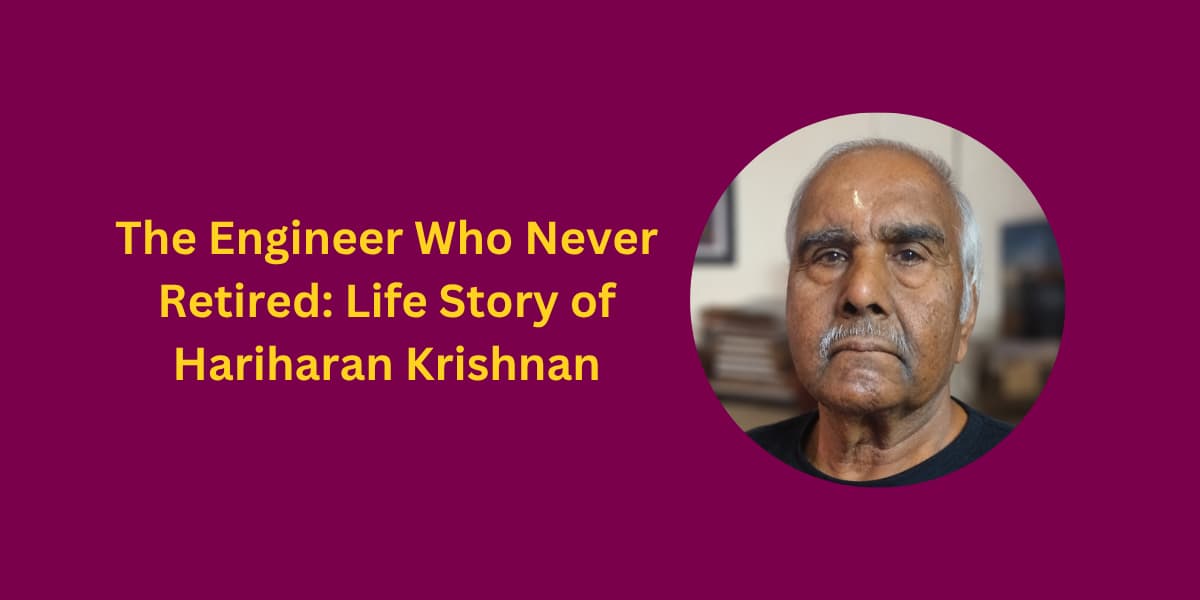
In a small village in Tamil Nadu, in 1950, a boy was born who would spend the next seven decades building things - plants, systems, networks, and, in his final chapter, a quieter architecture of purpose. His name is Hariharan Krishnan, and if you ask him what his life has been, he will not talk about titles or milestones. He will tell you it has been "a good number of challenges, a good number of learnings, and a good number of opportunities." It is a modest summary for a life - from village classrooms to cutting-edge computer rooms, from cement plants in Karnataka to fertilizer factories in Algeria, and finally, to a hospital helpdesk in Bangalore where he now spends his mornings listening to the worries of strangers.
Hariharan's family moved from the South to Calcutta in the early 1950s, chasing his father's new job, and it was there that he came of age, a pre-university stint at a Calcutta college, and then the leap that would define his professional life: admission to IIT Kharagpur, where he completed both his BTech and MTech. In 1975, armed with an engineering degree and a curiosity that would never quite switch off, he joined Rashtriya Chemicals and Fertilizers (RCF) in Bombay as an industrial engineer.
What followed was less a career than an evolving apprenticeship in reinvention. Hariharan and his colleagues were pulled into RCF's fledgling computer services department, and in 1977 he was sent to IBM's training centre in Delhi to learn programming on the IBM 1401, a machine so early in the history of Indian computing that, as he puts it, it is "now a relic." He wrote code in Auto coder, one of the first programming languages available in the country, to automate operations at RCF's chemical and fertilizer plant in Chembur. From there, he rode the wave of computing history nearly in real time: from COBOL on an ICL 2904, to Unix and C++, to Sybase databases, each upgrade a new language to master, a new system to build almost from nothing.
That instinct for building from nothing found its fullest expression when he moved to the Aditya Birla Group in 1992, taking charge of IT for a new cement plant in Malkhed, a remote village in Karnataka's Gulbarga district. There was no infrastructure to speak of, no network, no hardware standard, no playbook. Hariharan built one: laying underground cable, setting up nearly ninety terminals, rigging wireless links with dish antennas to reach a mining site kilometres away. When the dreaded Y2K bug loomed over the world's computers, Hariharan was one of the few who wasn't worried, his Sybase-based system stored dates in a way immune to the bug, and while entire organizations panicked, he was confident, nothing will happen. He was right. That quiet confidence would become something like his signature.
Perhaps the most demanding test of his ingenuity was of a different kind altogether: optimizing how boiler-quality pipes, extraordinarily expensive steel tubing, were cut to fit a thermal power station's exact specification. Using operations research, a discipline he'd absorbed on the job, Hariharan devised an algorithm that minimized waste, saving the company a substantial sum of money, in 1977. It's the kind of achievement easy to reduce to a footnote, but for Hariharan, it was proof that clear thinking could out-engineer expensive materials, a lesson his entire factory group carried forward.
His career would go on to cross oceans and disciplines: two years on deputation in Algeria in the mid-1980s, reviving a dormant fertilizer plant with a fifty-member Indian team, learning French well enough to speak it fluently with local workers; an award-winning SAP ERP implementation in Veraval, Gujarat, that earned him and his team a trip to Delhi to be honoured; and, after his formal retirement in 2010, a final act as Chief Information Officer at BITS Pilani, where he connected four campuses, including one in Dubai, onto a single PeopleSoft system.
Ask Hariharan about retirement, and he corrects you before you finish the sentence. "There is nothing like retirement," he says. "You have been relieved of your contractual work to do a work which you can do at your will and wish." In Bangalore, where he settled with his wife in 2013, his days now begin at dawn with filter coffee and a walk, followed by prayer, and then hours spent as a volunteer at the Sathya Sai Baba Hospital's helpdesk, listening to the concerns of patients traveling from across the country, matching them with doctors, absorbing roughly 150 calls a day with the same patience he once brought to fixing broken systems. He teaches Education in Human Values to nursing students and schoolchildren. He sings retro film songs from the 1950s and 60s at karaoke sessions, a devoted member of Bangalore's Mohammed Rafi fan club. He and his fellow volunteers, distribute food to those in need and sing devotional bhajans in the early morning streets.
His wife, he says with quiet pride, has become a self-taught culinary expert, drawing on cuisines from every state they've called home, Rajasthan, Gujarat, and beyond. Their daughter, an engineer and MBA working in IT, lives nearby in Bangalore.
Hariharan's philosophy, distilled from a lifetime of solving other people's problems, is disarmingly simple: idleness is the real danger, not age; peace comes only through engagement; and service, seva, offered without expectation is the one investment that never disappoints.
Seven decades in, Hariharan Krishnan is still building, no longer factories or networks, but something more durable still: a life lived in continuous, cheerful service to others.