
Monday, 5 October 2026
Charu Mathur: "How you "AGE" is in your hands”
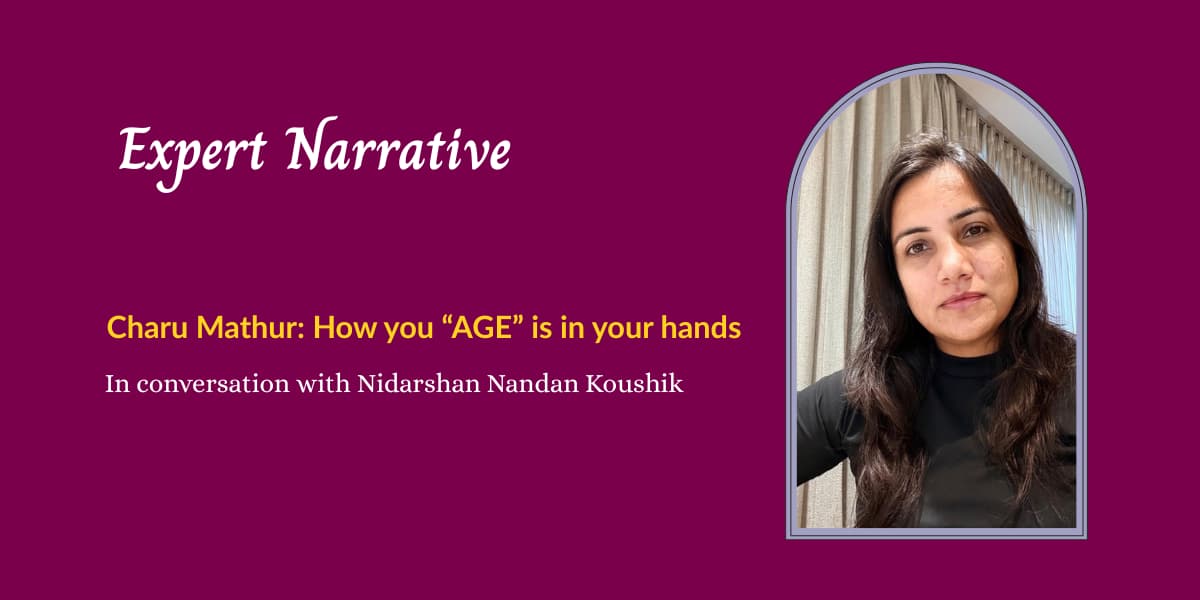
Charu Mathur: "How you age is in your hands”
Charu, you spent nearly two decades in banking strategy and consulting before building Pathya. What was the moment you decided the problem you actually wanted to solve was women's health?
I had spent close to two decades in banking strategy and consulting, so a lot of my work had been around looking at problems, understanding what was really going on, and figuring out what could be done differently.
And I think that way of looking at problems stayed with me. When I started noticing things around health, I began wondering, when you can see something going amiss, is there something you can do early enough to prevent the deterioration? And can you do that in a way that is science-backed and research-backed?
That was really the spark for Pathya. I started with women’s ahealth because it resonated personally with me, and that’s why our first set of products focused on women’s hormonal health.
There is a generation of Indian women who went from managing households and careers to suddenly being told their bodies are "changing" with no roadmap provided. How prepared, in your assessment, is the average 50-year-old Indian woman for what the whole process actually involves?
I think one of the things I strongly believe in is how do we make people live better and not just live longer. You can live till 80, 90, it's very normal nowadays for people to even reach 90 years, but if you look at the last decade of anyone's life, specifically in India, people are not really enjoying their lives to the fullest. Their mobility is restricted, and there are a bunch of other things that I find deeply disturbing.
I do believe that people should be able to live to their fullest and have really fulfilling lives till the very last day. They should be able to swim at the age of 90, they should be able to do a deadlift at the age of 90 if they want to. The narrative that with age, you can expect a certain level of degradation and deterioration is not entirely correct, because there's a lot you can do. A lot of how you age is in your hands.
Specifically talking about women after 50, addressing the elephant in the room: the big thing that hits is menopause. At least the discussion around menopause has started happening a little more openly on social media. But we never got to know when our mothers hit that stage in life and what they experienced. Did anybody educate them on what is changing inside their bodies and how they should be changing their lifestyle to cope with those changes?
This should almost be like curriculum knowledge that every woman should go through when they start hitting their 40s.
One of the key changes is hormonal. There is one extremely important hormone, not just for fertility but for so many body functions and that's estrogen. That is the key hormone your body stops producing because, as you hit menopause, you don't really ovulate, and you therefore don’t reach that stage in your cycle where estrogen will be produced. That has so many ramifications: for your bone health, your risk of developing visceral fat, cardiovascular diseases, metabolic disorders, motor function, depression, anxiety — all of that.
This should be almost like textbook knowledge handed out to every woman dealing with this in their 40s and 50s.
"The narrative that with age you can expect a certain level of degradation and deterioration is not entirely correct. A lot of how you age is in your hands."
There's a landmark study you reference often — the LIFTMOR trial. What did it prove, and why does it matter so much for Indian women specifically?
Your bones are constantly getting remodelled. There are cells that are breaking as well as old bones and cells that are making new bones. Estrogen has been clinically proven to impact that activity — so after menopause, you end up breaking more than you build. That is why bone health becomes such an important thing to focus on for women in this age group.
The LIFTMOR trial was done in Australia on postmenopausal women — 101 women, aged 60 to 70, average age 65. They gave them two resistance and impact training sessions per week, 30 minutes each, and measured if it positively impacted bone density. They made these women do deadlifts, progressively overloading, well supervised — squats, deadlifts, some jumping exercises. Instead of losing bone density, the women showed increasing bone density. Their bone density went up by 2.5%.
It's amazing to see how your body can respond to your environment, your diet, your exercise, the stimulus you give it externally.
That's why I am a big proponent: any woman after 50 must lift a little bit of weight. Resistance training is so important. Along with that, you need to focus on your diet — the calcium, vitamin D, and protein intake, which the Indian diet is quite deficient in. At least 1 gram per kg of your ideal body weight, roughly 60 to 70 grams of protein, is something everybody should try and get on a daily basis.
I see a lot of people focusing on walking and maybe yoga, which is good. But you must add resistance training and impact training if you are over 40. That is something Indians specifically miss out on.
Marzi is primarily working on community building — so that people can meet others from the same stage of life. Women in this age group have been primary caregivers their entire lives. If hormones are in flux and they're not really aware of it, how does that affect their ability to respond to exercise, wellness routines, social events?
I think there is so much information now. They should read credible sources — because one of the downsides of having so much information is that you don't know what to trust. But there are enough reliable, science-backed sources out there. I do encourage every woman to read up on what these hormonal changes mean and how they should update their diet, lifestyle, and exercise pattern.
And just measure. You should get an annual screening done, and in that screening you should also include your hormones. Not just in menopause but even in perimenopause, so you can start understanding these shifts sooner and start adjusting your life according to these changes.
One more thing I want to talk about is that this is also the age where most people end up with an empty nest. And a lot of people sacrificed so much for their kids' education, left their careers. Suddenly you have this empty nest. So one of the things which I feel is so important to focus on is your cognitive health after 50. That's where depression hits, and you get very anxious and lose a sense of purpose.
Building social connections outside of what you have at home is so important. Picking up a new skill — you can learn music at the age of 50, don't bother how people will react — it's just good for your cognitive health, your mental health. Just getting out of the house, meeting people, like-minded people, being able to share, travel together, having social connections — it's very, very important.
"Picking up a new skill, you can learn music at the age of 50, don't bother how people will react — it's just good for your cognitive health, your mental health."
Women in this age group have been primary caregivers all their lives. At what point does that pattern become a clinical risk, not just a lifestyle observation?
People should understand that eventually they cannot create a good environment at home if they are not fully fit mentally and physically. Even if one person in the house goes through a chronic ailment — hypothetically, if you have somebody dealing with Alzheimer's or somebody going through kidney dialysis — it takes a toll on the entire family.
By not taking care of yourself and eventually landing up in some very chronic issues mentally or physically, you are doing a disservice to the very family that you thought you have been sacrificing so much for. A little bit of that selfishness — or self-awareness — is important just for the sake of having a good, healthy environment for the family that you so dearly love. Unless you are at your best, you won't be able to create that best environment. If you fall mentally and if you fall physically, everybody in the family is going to suffer too.
Connecting to that — retirement can be a very lonely time. Kids have gone, no job, no routine. How does having a community, hobbies, something to look forward to — work psychologically at this stage?
In India, we are basically taught to just study, study, study — that is most important. But suddenly if you don't have any other dimension to your personality, once you are done with your work life, you are a full vacuum.
I have seen people who have hobbies — whether gardening or keeping an aquarium — and after retirement they are involved full time in those hobbies. They feel passionate about it and are able to create small communities around it. I know somebody who is part of a horticulture group — he nurtured his hobby of gardening so much that now he's trying to help the community in his area build best practices of permaculture or waste management.
You can always nurture a hobby and make it more meaningful. But you should also be open to learning at any age. Even if you could not pick up something while you were young, you should be open to learning and picking up something even at the age of 60, just giving fresh purpose to your life. Teaching kids in the neighbourhood, taking tuition classes, joining your local community cultural committee — in whichever way you can contribute meaningfully, you should just get involved.
If you could change one thing about how India's healthcare system talks about women after 50, in their 60s and 70s, what would it be?
One thing I want in the healthcare system to change is a move from a banded approach to a more root-cause-based approach. When your fasting sugar is 110, your doctor will say start metformin. But what if it is 105 or 107? Who decided that 110 is the tipping point? What do I do when I am seeing the amber signals? I know there is a cure when I reach the red — you will put me on a medicine for life. But that comes with its own side effects. What do I do when I am picking those amber signals? I would want more of that narrative to happen.
Specifically for women's health — one thing I would like to see is more open discussions. Hormonal health is so much beyond fertility; it is about your entire metabolism. But it is very hush-hushed.
I know girls who are getting diagnosed for PCOS when they are hitting 30, 35 and trying to conceive — but they had symptoms right from when they were 18. And somebody in the family just told them that pain happens, irregularity is okay, don't make a big deal about it. Some of these things also create elevated risks for certain types of cancer. There has to be more scientific, clear education on these things. There has to be more open dialogue.
"Hormonal health is so much beyond fertility — it is about your entire metabolism. But it is very hush-hushed."