
 Back to Wisdom from our Community


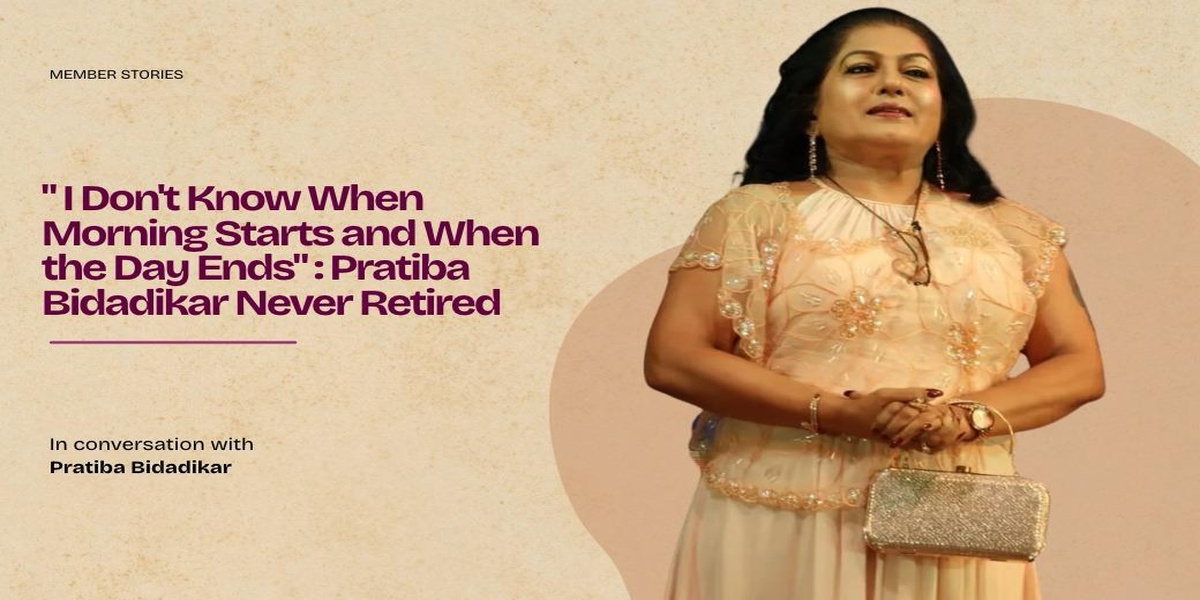
"I Don't Know When Morning Starts and When the Day Ends": Pratiba Bidadikar Never Retired
Pratiba Bidadikar, a native of Karnataka, educated in Maharashtra and Delhi, a former S&M Management Professional for 2 decades in the Middle East; Now a Multilingual Actress, Model, Anchor, Podcaster, Singer - in English, Hindi, Kannada, Marathi and Tamil.
When Pratiba arrived in Mumbai, she had one phone number and knew nobody. She also owned several properties in Bengaluru, yet she moved into shared living. If she was going to be a stranger, she would be the one who paid her own way.
She had left her salaried career in sales and marketing management behind in 2019. Today she is back in Bengaluru, and her calendar has stopped making sense. "I don't know when morning starts and when the day ends," she says. This October was the first of her life with events back to back from the 2nd onwards. On the day we spoke, tomorrow meant a ladies' kitty-party lunch at the JW Marriott, where she was a guest rather than a member. The day after was Marzi's Sundowner.
We asked whether she was retired. "No, no, I've never retired," she said. "I retired from a 9-to-5 job as a sales and marketing management professional in 2019, and then I became a full-time artist."
"To be or not to be"
The salary came first, and it was bought with distance.
In 1995 Pratiba was ten years into her career in Bengaluru. She had been married since December 1989 and had a son born in 1993. Things at home, she says, were going through "a very rough patch." Then an offer arrived from an international exhibition-organising company in the Middle East, with marketing across the GCC and a lot of travel attached.
She meant to take her mother and her son with her. Her mother had just started a bakery that her younger brother couldn't run alone, so she stayed. Pratiba's next idea was a helper from the interior of Karnataka. Her in-laws said no, and she says they were right. She would be travelling, the child might be alone with someone who spoke only Kannada, and in an emergency that person couldn't make herself understood in English or Hindi.
That left her with a choice she describes as "to be or not to be." Leaving her son behind, she says, was "the biggest challenge I ever faced in my life." He was a child she had once been told she would never have, and he was born with great difficulty.
A close friend in London, told her to take the job. Staying in India meant twenty-five years of struggling to raise a child and build something alone. Going, even for eight or ten years, could leave her with real assets for herself and her child. She went.
The first three years were extremely difficult. The package gave her one month's leave and a ticket every two years, so she asked her employer, a South Indian owner, whether she could fly home more often. He agreed. "I couldn't save anything for the first few years," she says, "but I could fly as many times and spend time with my child."
After that came ten years in Dubai, a year in Bahrain, and a year in Lagos as a centre manager. She came back to Bengaluru when her son was sitting his 12th board exams and stayed until he had graduated and been hired by Amazon. He is also a footballer. Only then did she return to Dubai for five more years. She gives the credit to her friend in London and to her parents. Her mother, she says, was "a very big support."
Everything she did later with her time had been paid for in advance. Today, she says, she lives "very happily, healthy, and peaceful" because she made assets and made sure she had an income.
A salary person with no salary
The stage had been running alongside the salary for years. In Dubai she sat on the executive organising committee of the Karnataka Sangha and the Maharashtra Mandal, and she anchored their cultural evenings. She had also grown up and been schooled in Maharashtra, and she speaks English, Hindi, Marathi, Kannada and Tamil fluently. For years, friends and family told her that her destiny was in Mumbai.
She had tried the stage once before, between 2010 and 2014, while her son was in Bengaluru. She worked as a solo anchor and singer and had back-to-back events. But payments went wrong, and there was politics and competition. "I was very innocent," she says. After that she was careful.
"I've been a salary person all my life," she says, "and neither did I have any backup, to be very honest with you." Her father had passed away. Her elder brother, whom she loves, was looking after himself. She had no husband to lean on. The entertainment industry, she points out, does not pay a confirmed monthly income, and she wasn't willing to walk into it without one.
So she waited until the numbers worked. The pandemic kept her at home for two years, singing on Facebook Live, and by the end of it plenty of people in Bengaluru knew her face. Then she went to Mumbai, where, as she puts it, she "set foot as a total stranger with just one number."
She had been an outsider before. When she joined Emirates Neon in Dubai as a sales manager, she was the only woman on the team and the only manager who wasn't an engineer. She had no UAE experience, while her four colleagues had four or five years each. She heard what they said about her in the canteen. Her answer was, "My work will speak."
In the morning meetings, every construction site in Dubai and Sharjah was already someone's client. So she asked her managing director and general manager for a few days without reporting in, and drove two or three hours to Fujairah and Ras Al Khaimah. In her third week she landed 20,000 dirhams' worth of signage for a new club tied to an international boat race. She stayed with the company for five years and was promoted. Mumbai was the same move on a larger scale.
She acts in films, YouTube series, web series and TV series. She models for television and digital commercials, testimonials and documentaries. She sings, anchors, hosts, does voiceovers and dubbing, and translates. She came home because her son had to get married, and because she wanted a base in Bengaluru, "where I'm going to spend the rest of my life." She still works across India and abroad whenever a project calls.
"Pratiba, join us here"
Coming back, she found that the work was the easy part to plan. "You have your professional life, which you have planned," she says. "But then, social life."
She had been away from Bengaluru for twenty-five years and had lost contact with her friends. A couple of them had passed away. Many had moved abroad or to other states with their children. Family and weddings gave her somewhere to go, but, as she describes it, you say hello and come back.
Last autumn she kept scrolling past Marzi on Facebook. After four or five days she clicked, saw that it was for people over fifty, and joined. In the year since, she says, she has attended every event, online and offline. That includes coffee meets, karaoke and the monthly Sundowner. Marzi has used her photographs in its marketing. Its sister company, Primus, offered to pay her to model for them.
"It's like 24-7," she says. "Somebody's calling, somebody's messaging: Pratiba, join us here. Pratiba, let's go there." She says it "completely filled the void in my life."
Her days now have a shape, though a loose one. She is up by 6.15 and at the gym opposite her house for an hour at most. Then comes the housework, and then the good-morning message, which she posts to her WhatsApp status every day because "all my Marzi and friends and everybody else, they're all watching, and they wish back." That takes about an hour.
Afternoons she has recently spent in a Kannada devotional-song class with about fifteen women who, she says, have graciously made room for her. She speaks Kannada fluently but never learned to read or write it. She has learned the basics now and is still struggling with the compound letters. Her karaoke group is moving up to live singing. "Live singing is much more difficult and challenging," she says. "Karaoke is very easy. You just switch on and start singing."
At a Punjabi Sabha the day before we spoke, she was teaching a woman the basics of dandiya. The woman became a friend and invited her home that same day. A call can also arrive with two hours' notice. For the coming Halloween, she had just been offered paid work playing a character, and her answer was "Yes, sure, why not?"
Sweet and bitter
Her son still lives with her ex-husband. She divorced about thirty years ago and has been single since. Of the arrangement she says: "He loves me, I love him, we meet, we spend time, and there's a very beautiful understanding." Of the boy she left in 1995, she says only, "He's a great guy."
She describes her way of facing things almost like a technique. The fear, she says, lives in the stepping in: "What if I? What if I?" Once you've put your foot in, "the fear is gone, because now the thoughts of solution overtake your mind." She learned the other half from her mother: "Never, ever give up."
She calls life "sweet and bitter," using the Kannada saying for it, and says it has to be taken in stride. "No problem is ever permanent in anybody's life," she says. "Temporary."
On 3 October the Bangalore Women Power Group had named her a winner in Arts, Culture and Experiences, for multilingual performing arts and screen acting. There were many other certificates, she said, from women's groups and from her Dubai years.
Comments (0)