
Monday, 15 June 2026
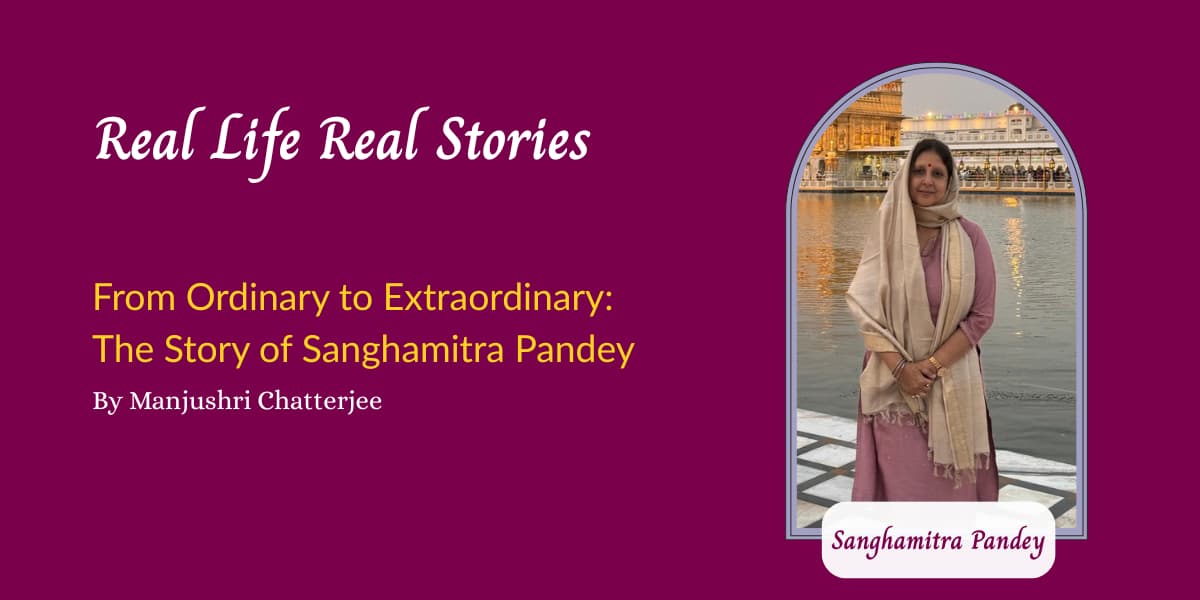
From Ordinary to Extraordinary: The Story of Sanghamitra Pandey
Discovering Her True Calling
There are some lives that seem quiet on the surface yet carry within them the power to inspire generations. Sanghamitra Pandey's journey is one such story—a tale not of fame or fortune alone, but of self-discovery, courage, and the realization that it is never too late to honor one's soul.
Sanghamitra was born on April 23, 1971, in Kolkata, India. Her childhood was divided between Dehradun and the lush landscapes of Assam. Among these places, Assam captured her heart most deeply. She spent countless hours outdoors, wandering through nature, listening to birdsong, and watching the gentle river that flowed behind her home. Nature became her first teacher, filling her young mind with wonder and peace.
One of the strongest influences in her life was her paternal grandmother. As a child, Sanghamitra watched her grandmother live a life of remarkable discipline and grace. Every day followed a rhythm of prayer, household responsibilities, reading, caring for family, and evening walks. There was balance in everything she did.
To many, it may have seemed like an ordinary life. To young Sanghamitra, it was extraordinary.
The discipline, devotion, and simplicity of her grandmother's life quietly shaped her own values. She learned that dignity did not come from grand achievements alone, but from the way one lived each day.
When Sanghamitra was in the fifth grade, her family moved to Dehradun. The transition was difficult. She missed the forests, the river, and the familiar companions of her childhood. For a young girl who felt deeply connected to nature, the move felt like losing a part of herself.
But time, as it often does, became a healer.
Gradually she adapted to her new surroundings and embraced the next chapter of her life.
As she grew into adolescence, Sanghamitra noticed something unusual about herself. While many of her siblings dreamed of careers, ambitions, and future accomplishments, she felt no such urgency. She loved simple things-reading books, listening to music, cooking, helping with household responsibilities, and simply being present in life.
She was happy.
Not because she lacked dreams, but because she found joy in ordinary moments.
After completing her education, Sanghamitra married and entered a new phase of life. Marriage brought significant changes. She moved from the familiar world of her parental home into a socially active environment. New relationships, new responsibilities, and new experiences expanded her horizons.
At the same time, her spiritual nature remained strong.
She gradually learned an important lesson: spirituality and worldly life need not stand in opposition. They could coexist beautifully, each enriching the other.
Yet one question quietly remained unanswered.
Society often measures success through careers, titles, and financial achievement. Sanghamitra felt no pressure to chase these milestones. She was content with her life and grateful for what she had. Still, somewhere deep within, a part of her soul waited patiently for its true calling to reveal itself.
That revelation arrived during one of the most challenging periods of her life.
When Sanghamitra entered her fifties, she faced a profound personal loss. Her father became seriously ill. In the months before his passing, he lost his eyesight, and she spent precious time caring for him.
During those difficult days, she often read the Bhagavad Gita aloud to him.
What began as an act of love soon became a turning point in her own life.
The wisdom of the Gita stirred something within her. Questions she had never asked before began to arise.
Who am I?
Why am I here?
What is the purpose of my life?
What does it mean to truly honor one's soul?
After her father's passing, these questions remained. Instead of avoiding them, she embraced them. The teachings of the Bhagavad Gita offered her a new understanding of herself and her place in the world.
She realized something profound.
It was not that she lacked dreams.
It was not that she lacked ambition.
Rather, she had spent much of her life overlooking the unique dreams that belonged to her soul.
The Gita taught her that a deeply spiritual life does not require abandoning worldly success. One can nurture both inner growth and outer achievement. Balance, not renunciation, was the key.
Armed with this new clarity, Sanghamitra decided to spread her wings.
She followed a passion that had quietly accompanied her throughout her life—a love for traditional Indian clothing, textiles, and craftsmanship. Her appreciation for the artistry of different regions of India inspired her to step into entrepreneurship.
What many people would have considered an ending became her beginning.
She founded her boutique, Qala Elegant Tales, in Dehradun.
The venture was not merely a business. It was an expression of her creativity, her respect for Indian traditions, and her newfound confidence. For the first time, she fully embraced the call of her soul.
The woman who had once been content simply to observe life was now actively shaping it.
Her journey carried an important message for everyone who crossed her path.
Simplicity is powerful.
There is no deadline for discovering who you are.
There is no age limit on transformation.
Some people are called to live a peaceful and quiet life. Others are called to make bold changes. Neither path is superior. What matters is understanding your own soul and honoring its truth.
Today, Sanghamitra Pandey's story stands as a reminder that life's greatest chapters are not always written in youth. Sometimes they begin after fifty. Sometimes they emerge afte loss, reflection, and spiritual awakening.
And sometimes, the journey from ordinary to extraordinary begins the moment we finally listen to the voice of our own soul.