
 Back to Lessons from the Experts


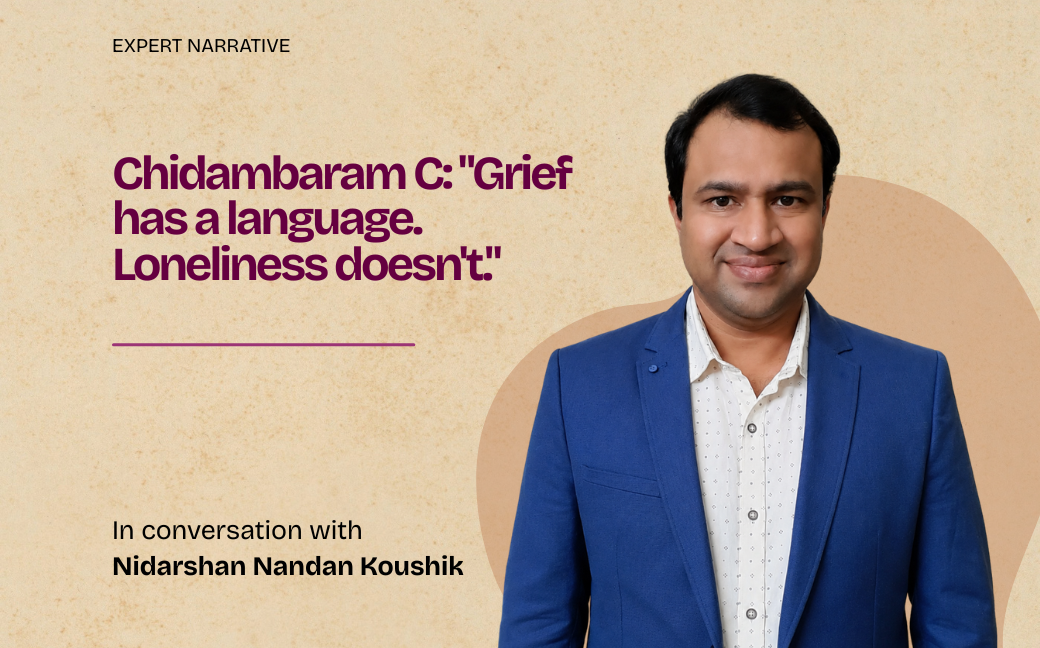
Grief has a language. Loneliness doesn't.
When someone loses their partner at 60, what is actually collapsing? And why is loneliness a much larger problem than grief alone?
The first thing to understand is that when someone loses their partner at around 60 or 65, they are not just losing a person. They are losing an entire way of life.
People at that age have often lived together for 25, 30, sometimes 35 years. They have been making decisions together, building daily routines, sharing a social circle, planning finances, celebrating festivals with family. And beyond all of that, there are the smallest things too. A conversation over a cup of coffee. A quiet exchange during dinner. All of that disappears overnight. And now, for the first time in decades, they have to make every single decision alone.
So many things change simultaneously. And this is why I see finances, mindset, and life goals as deeply interconnected. Because a person who has just lost their partner is often asking themselves three things at once. What does my financial situation look like? What does my future look like? And how do I carry this weight emotionally?
Now, grief and loneliness are not the same thing, and this distinction matters. Grief has a language. Society understands it. When someone hears that a person has lost their spouse, they know how to respond. But loneliness hits differently.
Someone can have their children around them, relatives calling regularly, friends visiting. And still feel completely alone. Because what they are missing is not just physical presence. They are missing the person who knew them deeply. The person they could call at any hour without thinking twice. The person who understood not just what they were saying, but the context behind it.
Grief is about losing someone's presence. Loneliness is about losing the sense of connection and the shared life that came with it. That is a much harder thing to name, and a much harder thing to heal.
"Grief is about losing someone's presence. Loneliness is about losing the sense of connection and the life that came with it."
In Indian society, there is a particular stigma around wanting companionship again after loss, especially for women. What does it cost someone to internalize that stigma?
This stigma comes from societal conditioning. We assign roles to people based on their age. There is an invisible, unwritten script that gets handed to everyone, and it goes something like this: you marry in your 20s or early 30s, become a parent, raise your children, ensure they are married, and then become a grandparent. At that point, society expects you to exist purely in service of that role. Any need for new companionship or intimacy is considered inappropriate, even shameful.
Nobody tells you this explicitly. It is an unwritten rule. But it shapes everything.
And for women, there is always an additional layer of social judgment. Remarriage, or even the desire for new companionship, is still largely unacceptable for women who have lost their husbands in India. So women in this situation start telling themselves: if I think about this, what will my children say? What will relatives think? Am I being selfish? Should I even want this?
Here is the important part. No one is telling them these things. They are telling themselves. That is what conditioning does. And once that inner voice takes over, they stop exploring possibilities even before they have given themselves permission to consider them.
We need to understand that our social rules and traditions were created by human beings, at a particular point in time, based on what felt right then. What was right then need not be right now. Times have changed.
And one more thing. Wanting a new companion is not a rejection of the life you already lived with another person. It is not forgetting them. It is an acknowledgement that you are still alive, still capable of connection, and still deserving of a life that feels full.
"Wanting companionship is an acknowledgement that you are still alive, still capable of new connections, and that you want to live a fulfilling life for as long as you are here."
What stories are people in this age group telling themselves, beyond the social pressure? And how do those stories hold them back long after grief has started to lift?
We do not respond to what happens to us. We respond to the meaning we assign to what happens. That distinction is everything.
After losing their partner, people create conclusions about themselves and their future. They tell themselves: I have lived my life. I should not expect more. Wanting someone new would be a betrayal of the person I lost. Or even: who would accept me now, at 60 or 65?
When these thoughts run on repeat, over months and then years, they stop being thoughts. They become behaviour. People in this situation begin isolating themselves. They stop attending family gatherings. They stop reaching out to make new friends. They confine themselves to their homes. And then, because no new connection forms, they take that as proof that their belief was always true. See, they say to themselves. It really is not possible at this age.
But the fact is, they never created an opportunity to find out otherwise.
It is like believing you cannot swim, and then never getting into a pool, and then concluding that your belief was right all along. You came to a conclusion without ever making the attempt.
This is where tools like NLP are genuinely useful. Not because they are magical, but because they help people examine whether a thought is actually a fact, or simply a story that has been repeated so many times it began to feel like one.
There is a difference between being ready to socialise again and being ready for genuine closeness. How do people know where they stand, and what does the journey between the two actually look like?
You can be open to being around people long before you are ready to let someone truly know you. Those are two different things.
Socialising is attending an event, meeting people, laughing, participating, even making new contacts. None of that requires you to be emotionally available. Closeness requires something more. It requires a willingness to be vulnerable.
Here is a simple example. When someone at an event asks how you are, what do we almost always say? We say fine. We say doing well. That is the default. Even when we are struggling, even when we are unwell, even when something is weighing heavily on us. We say fine.
But with someone we are genuinely close to, we can say: I am not okay. And then explain. We can share what is actually bothering us. That kind of honesty only happens when there is real connection. It does not happen at the surface level.
So people can usually feel the difference quite naturally. When they notice they can speak honestly with someone, not just pleasantly, that is when they are moving toward closeness. The socialising comes first. The closeness builds slowly, only if there is the courage to be real.
You left a long corporate career to build a more intentional life. For someone at 60 or 70 who has spent decades being someone's spouse, someone's parent, someone's colleague, and now none of those identities feel active, what does building an intentional life actually look like?
This happens because people link their identity to their roles. From childhood onwards, we are always someone. Someone's child, a student, a professional, a spouse, a parent. Those roles become who we believe we are.
So when those roles shift or disappear, there is often a much deeper question underneath: who am I now?
The first step is not to find another role to fill. It is to understand who you are when all the old roles become less relevant. And that is genuinely difficult, because for many decades, people have derived their sense of self from being useful to others.
A few questions can help. What gives me energy right now? What really matters to me at this stage? Who are the people I want to spend time with? Is there something I always wanted to explore, but never had the space for? Is there a contribution I can make, to family, to community, to someone who could benefit from the experience I have built over decades?
An intentional life does not always mean dramatic reinvention. Sometimes it is as simple as nurturing two genuinely close friendships rather than maintaining 25 surface-level ones. Or mentoring someone using experience that took 40 years to build. Or learning something new. Or finally travelling, if that was always the thing you wanted to do. Or organising your finances with more intention.
What it does not mean is trying to recreate the life you had in your 30s or 40s. That is not the goal. The goal is to ask: given where I am today, what would feel meaningful to me now?
If people can answer that question honestly and then move toward it, even slowly, they will age well. Not by some external standard, but in the way that actually matters. Feeling like your life is yours, and that it means something.
"Ageing well doesn't mean trying to recreate your 30s. It means asking: given where I am today, what kind of life would feel meaningful to me now?"
Comments (0)