
Thursday, 8 October 2026
Maltesh S: "The Retirement Math Most Indians Are Getting Wrong"
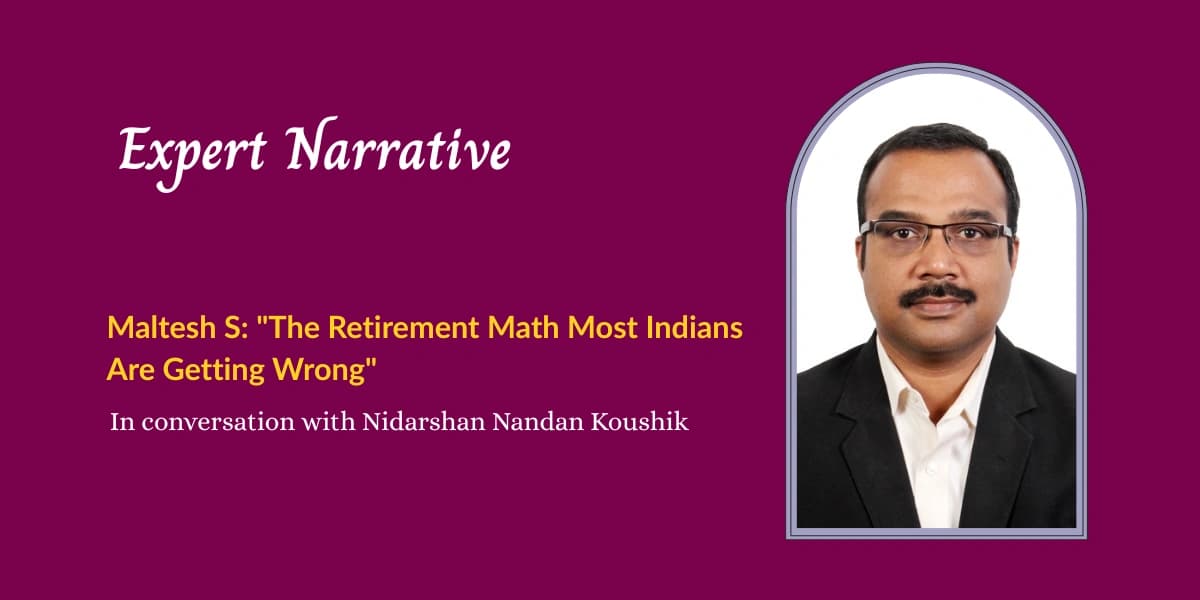
Short Profile
Name: Maltesh S
Occupation: CEO & Director - Supercraft3D
Most Indians in their 50s have spent three decades optimising for everyone else — children's education, parents' healthcare, family obligations. By the time they turn to their retirement corpus, how much runway is actually left?Most Indians in their 50s have spent three decades optimising for everyone else — children's education, parents' healthcare, family obligations. By the time they turn to their retirement corpus, how much runway is actually left?
There is an economic term called ceteris paribus, a Latin term which means other things being equal. Unfortunately, that's how we approach old age. We assume that the kind of lifestyle we led will be the lifestyle that the children will lead. We assume that the kind of expenses we have will be similar to the kind of expenses they'll have to focus on, be it their kids, their healthcare.
And one of the other assumptions we make that Gen X, or the generation before that, they didn't spend too much money on travel and on self-indulgence. Today's generation is not bothered about that; they're not bothered about saving. They want their parents to take them abroad, even if it means swiping the credit card.
So, when you come to the question of how much runway, I don't think there is as much as most families believe they have. When you speak with older people, only about 10-15% will say they have enough savings to last their lifetime. But 85-90% will say that they wish they had more savings. And about 50% of that group will feel that they don't even have enough for organised living needs.
The other aspect is that healthcare inflation is much faster than any other inflation in this country. The cost of healthcare is in double digits each year. Most middle-income families in India and this is one of the statements I would like all of them to hear — most middle income families are one major healthcare shock away from moving from middle class to poor. The moment someone in the family has a major accident, a stroke, cancer: one major disease is enough. Very few can take the shock of a major healthcare incident and still be financially sound.
The only asset many parents are left with is a non-liquid asset such as a house. They are asset rich but cash poor. They have a house, but you can't add cash to it just because you have a home.
Runway is one accident away from middle class to low class.
"Most middle income families in India are one major healthcare shock away from moving from middle class to poor."
You have a CA background and legal training, two disciplines that deal with risk very differently. When you look at a 55-year-old who has never had a dedicated financial plan, what is the single most dangerous assumption they are carrying?
They'll assume that their domestic expenses will remain flat. Electricity charges, food charges, there's an assumption that these things will remain constant but they don't.
The cost of domestic help has skyrocketed. If a 52-year-old today is hiring domestic help at 5,000 rupees, when they are 80 — 30 years from now — it's not going to be 5,000, 6,000, or even 10,000 rupees. It's going to be in lakhs. And their savings aren't going to grow at that rate. Their FDs are not going to grow at that rate.
A lot of people are invested in mutual funds, which over the last five to ten years have hit significant highs. I won't deny it was a good investment. But it's also one bear market away from going down by 30-40%.
The third assumption is that someone will always come to help. There is an integrated inner belief system — the village system, the joint family system — that someone will always be there to care for them. In a city, in a family so divided, even if they have two children living in two different cities, the chances that those children can leave their jobs and attend to a daily need is limited.
Someone will say, "I have 5 crores in my bank, and I think that's more than enough." The question is: that person may have extremely good health, and 5 crores may have been enough for them. But it cannot be generalised. If you have not planned your resources, it's never too late. But you really must do it.
Healthcare inflation in India is running well ahead of general inflation. What does a realistic healthcare cost projection look like after 50? And how does it change the numbers people thought were safe?
Medical inflation is already in double digits. The general inflation is about 2-5%. But if you take individual items, food inflation and medication, those are at 15% plus. 15% sounds less when you say it as an isolated number. But 15% means it doubles your premium every five years.
If you are paying 30,000 rupees for an annual health insurance premium today, you'll be paying 60,000 rupees in five years.
Now let's assume you put your savings in FDs and you're getting 6%. This eventually becomes 4% because 30% of it goes off as tax. You have an FD that earns four 4%, but your inflation is at 15%. If you have planned retirement for 30 years, you could be out of savings much earlier.
Let's take the cost of joint replacement, which is very common nowadays. A typical replacement at a good hospital is about one lakh rupees currently. By 2040, a knee replacement is expected to cost about 15 lakhs because people are expecting better implants and robotic surgeries. And because everybody's under insurance, people are willing to pay. But remember that insurance covers a certain amount, and the insurance premium is going up at 20% even for a general policy.
A friend of mine had something as simple as haemorrhoids. The cost was 2 lakhs. He works at an IT company, salary about 75,000 a month. It cost him roughly three months of salary. Assume he had already retired and was getting a pension of 75,000 — three months of pension, wiped out for a one-day surgery.
As we grow older, we'll need diabetes pills, BP pills, and thyroid pills. Those are a monthly spend of 5,000, 6,000, or 10,000 rupees — almost a lakh every year from your own pocket. The little little drops add up to a big puddle.
"If you have planned retirement for 30 years, you could be out of savings much earlier. Every time you have a major medical issue, the timeline shrinks."
The legal dimension — wills, nominations, joint asset structures — is almost ignored by the 50-plus generation until a crisis appears. What's the gap you see most consistently between what people have documented and what they assume is covered?
It's cultural. Somewhere it is inherent — the splitting of property between children is considered a topic most people are very uncomfortable to discuss.
90% of people have never thought about making a will. And of the remaining 10%, two or three will say they have no plans to make one. The challenge starts once the person is deceased, and that's where the children start fighting for assets. A significant portion of those fights will end up in courts and courts to take anywhere between two to three decades to decide. Not two to three years. Two to three decades.
Parents who are 50-plus and have not made a will, their children will go to court and spend the rest of their lives trying to get hold of their inheritance.
The other assumption is around nomination. People think that as soon as they nominate someone, that is inheritance. There are enough case laws to show that just because someone was nominated as the FD person, it doesn't mean that asset belongs to that person once the nominator expires. It still belongs to the estate. A nominee is a trustee or a receiver, not a successor.
Most people don't have a will and have no intention of creating one. And when they don't, the existing 50-plus will end up going to court, spending a lot of their retirement funds fighting a battle. And if someone becomes incapacitated with a stroke, the ability to even fight those assets becomes even more limited.
There is a belief in our community that if you haven't built serious savings by 55, the game is largely over. Is that true? Or is there a realistic case for meaningful financial course correction in the last decade before retirement?
There is a price for delays. Let's do some simple math. If you were to invest 10,000 rupees each month at the age of 30 and assume your mutual fund gives you 12% returns, by the time you are 60, you will have roughly 3 to 4 crore rupees. Now, if you want the same 3 to 4 crores at 60 but you are already 50, you will have to put 1.5 lakh rupees every month. What you were putting as 10,000 rupees a month from age 30; you now have to put 1.5 lakhs. That is the price you pay for being late.
The good part is that at age 30 you are probably earning 20 or 25,000 and putting 10,000 of it away. At age 50 you are probably earning 5 lakh rupees per month. So, the percentage remains the same. But the 30-year-old has a runway of 30 more years. The person at 50 has another 10 or so. You always have pressure.
You cannot just play safely. You need to be very particular.
The person at 50 also has children's marriages coming up, children going abroad for studies, a higher risk of being diagnosed with something. The unpredictability of being able to save 1.5 lakhs every month for 10 years is much higher than you think.
So, the whole question is to start early. There is a huge price for delays.
But it also varies from person to person. Let's assume 30 years ago, you lived on the outskirts of Pune or Mumbai. That land is now worth a few crores per acre. That person is relatively safe even if he didn't make investments, because natural wealth has grown. But you can't say the same thing to a person who has lived on a salaried government job. Those are the people who are at risk. And unfortunately, they constitute 90% of the population.
"Start early. The whole question is start early. There is a huge price for delay."