
 Back to Wisdom from our Community


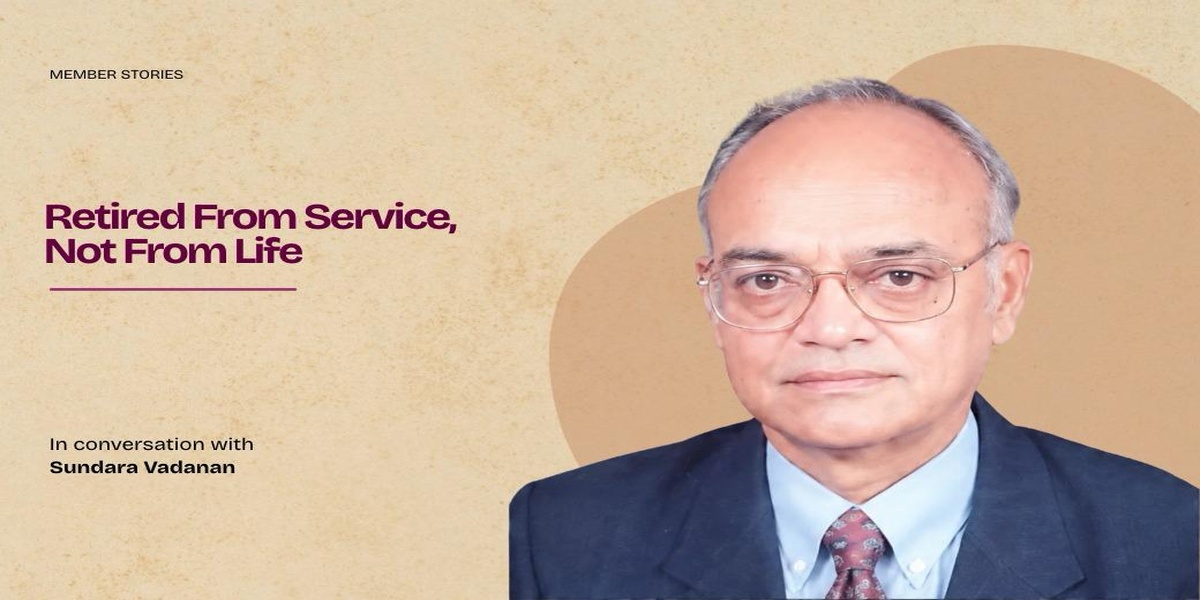
Retired From Service, Not From Life
Every morning around a quarter past six, Sundaravadanan Vaidyanathan ( Nick name is Sundar ) and his wife, Savitri Aiyar, have their coffee, and then he begins her day. He helps her brush her teeth, comb her hair and get dressed. With the daytime caretaker, he takes her in a wheelchair to the clubhouse. There he does his exercises while she sits nearby, and the elderly ladies of the complex stop to greet her with a namaste. Sometimes someone brings a grandchild in a pram to show her.
He is 85. He retired at 60 after a career in fertilizer marketing and distribution. "I have retired only from service," he says. "I have not retired from life."
The year the bat went down
Vaidyanathan grew up in in Tamil Nadu's Thanjavur district. He holds a postgraduate degree in statistics and a diploma in business administration, and he worked in several parts of India. Cricket ran alongside all of it. He played for his school, his college and his university, and he represented Annamalai University in the All India Inter-University Cricket tournament in 1962. He also played in the Tamil Nadu Cricket Association's leagues for 19 years.
He played until he was 60. "After that, only I stopped playing," he says. "Apart from that, my passion is writing." Cricket and the working life ended in the same year, and the writing took up the space they left. He doesn't describe it as filling time. "It gives me an opportunity to work," he says. "My mind is kept active."
One God Many Names
The first book is ‘One God Many Names’, published through Notion Press in Chennai. Its premise came from reading. Vaidyanathan has gone through the 6 Upanishads, the Bhagavad Gita, a few excerpts on Vedas, the Bible and the Quran, "very carefully, many times," and collected what they share. He settled on 22 topics, among them forgiveness, how each tradition prays, and surrender to God.
His reasoning is simple. "If you highlight the differences, you differ and you distance yourself from each other." The book is the opposite exercise. A 23rd chapter, on how the religions evolved over time, is already drafted, and he is preparing a second edition.
Photographs, six decades later
The second book began at the dinner table. His wife, Savitri, was born in 1948, in independent India. Growing up, she heard from her parents how their families escaped from Burma when the Japanese advanced in 1941. Her relative Kalyani, who had settled in Kuala Lumpur, would come to Madras and stay for months, telling more. "It is the only primary source of information for us," he says.
The stories are hard ones. Aunt Kalyani, Savitri’s mother, cousin, maternal grandfather, grandmother and the young Sita, escaped by trecking to different places. Two brothers missed the last steamer out of Rangoon and walked back to India. The trek took 90 days through the jungles of Nagaland, with hunger, malaria and robbers along the way.
The couple first thought of a small book for a relative in Kuala Lumpur. Their younger son, in Lucknow, suggested a coffee table book instead. Savitri told the stories, Vaidyanathan drafted them into storylines and edited, and survivors sent in accounts of their own. It took almost two years.
Photographs were the hardest part. "Believe me, after six decades," he says, they managed to trace relatives of those families, in Chennai, Mumbai and Kalyan, who went through their albums and sent pictures. The finished book runs to about 80 pages. The Coffee Table Book titled Iyerish Tales was presented to Sri G K Rama Iyer in KualaLumpur on 18th March 2018, surrounded by relatives. He shares the story with a hope, which is his wife's wish too: that anyone who lived through something similar will get in touch and share their own.
Teachers at four, and at eighty-four
The Burma book isn't the only family story he has written down. He is one of ten children. His mother died at 38, when the eldest was 17 and a half, and his eldest sister and her husband "took charge of the situation." He already has a write-up of that, too. Only a day before our conversation he finished an 18-page account of his school, college and university days.
Both books, and the pages about his own family, are about households that held together after a loss. He has spent his retirement recording that.
He is still a student as well. "I had teachers right at the age of four," he says. "And also I had teachers at the age of 84." For six years he went every Sunday to the Bangalore Tamil Sangam to study the Tamil classics, including Silappathikaram and Manimekalai.
One day at a time
A year or so ago, he and his wife moved into a senior living community. Her health means they no longer travel, and he is with her all day. "Health is one thing which is not in our hands entirely," he says. "So we accept it as it comes." Of his wife he says only: "She is very resilient. She is not a complaining type."
Their eldest son, Sriram, lives in the next block and often joins them for lunch and dinner. Their younger son, a dental surgeon in Lucknow, visits every three to six months. A granddaughter studying medicine at Manipal comes for a day or two when she can. He quotes a Tamil song to explain how he feels about all of it: "I have no regrets in life. We have been blessed in many ways, so we don't look at the shortcomings."
The afternoon belongs to the two of them. She has physiotherapy in the evening, he does his exercises, and then they watch an episode of B.R. Chopra's Mahabharat or a movie together. She is rereading a novel they both read soon after they married. He reads the newspaper, and then, as he puts it, he gets "busy with my own writing work."
The 23rd chapter is waiting.
Comments (0)