
Thursday, 23 July 2026
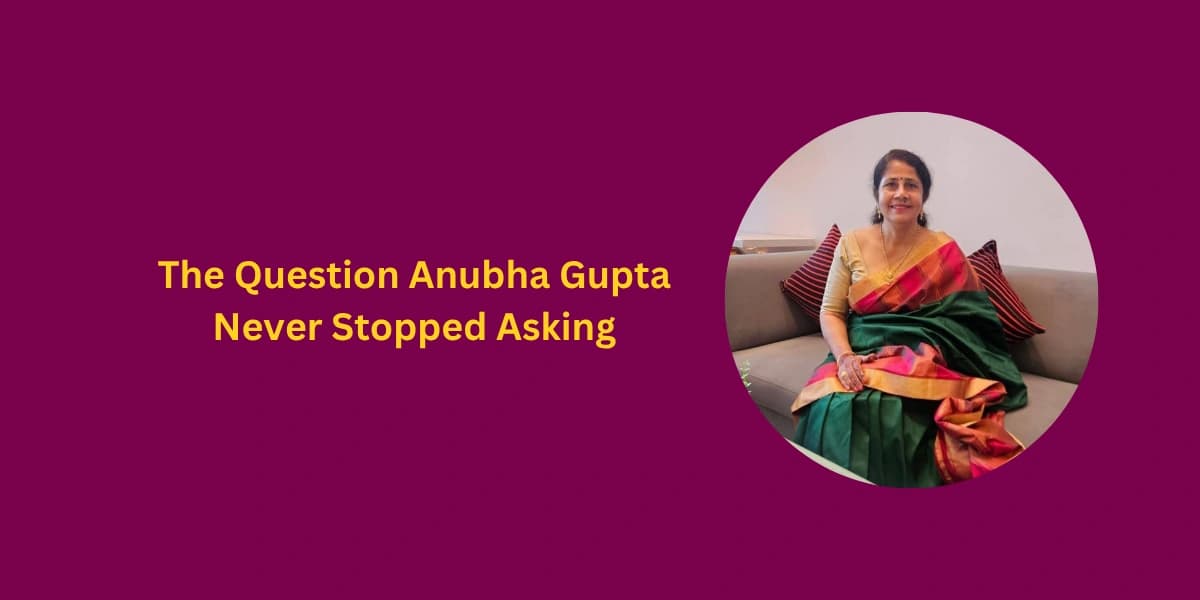
The Question Anubha Gupta Never Stopped Asking
The Pursuit of Meaningful Human Connection
Some people spend their lives collecting answers. Anubha Gupta has spent hers holding on to a question.
Why is it so difficult for people to truly connect with one another?
The question followed her through corporate boardrooms, into counselling sessions, across workshops on mindfulness, and eventually into the work she now does as a coach. It has outlived job titles, career transitions and even the frameworks she has created to explain wellbeing. If there is one thread running through everything she has done, it is an enduring curiosity about relationships, not romantic relationships alone, but the ordinary human connections that quietly shape the quality of everyday life.
Long before she began working as a mindfulness coach and counsellor, Anubha spent years in human resources.
The role placed her at the intersection of people and organisations, where conversations about performance, teamwork and workplace culture were part of everyday life. Yet beneath the language of appraisals and productivity, she kept noticing something else.
People worked together. They spoke to one another. They attended meetings. But genuine connection remained surprisingly rare.
The more she observed workplaces, the more convinced she became that the greatest challenge wasn't communication. It was authenticity.
People spoke, but carefully. They chose words that were acceptable rather than honest.
Difficult emotions were postponed, disagreements softened, and uncomfortable conversations quietly abandoned. Professional environments encouraged collaboration, but not always vulnerability.
That observation stayed with her long after she stepped away from corporate life.
Today, when Anubha speaks about emotional wellbeing, she rarely begins with meditation or positive thinking. Instead, she introduces a framework she calls CALM - a simple acronym that reflects years of observation rather than theory.
For her, the letter C stands for Connect. A stands for Activity. L represents Learning. M stands for Mindfulness. Together they form what she sees as the foundations of holistic health.
Most people, she believes, pay attention to physical fitness, intellectual growth and even spiritual practices. They exercise, read, attend retreats and learn new skills. Connection, however, is often neglected. Ironically, it is the simplest part of the framework and the one she finds people struggle with the most.
Over the years she has watched the same pattern emerge in workplaces, friendships and families.
Parents hesitate to express disappointment. Children avoid difficult conversations because they fear hurting their parents. Colleagues misunderstand one another without ever discussing what went wrong. People carry emotions quietly for years, assuming silence will somehow protect the relationship.
She believes the opposite often happens. Silence protects discomfort and not relationships. This perspective also shaped her association with Sukoon in its early years and, later, with Marzi.
The idea behind both communities resonated immediately because they were attempting to address the very question that had occupied her for years: how do people create meaningful relationships later in life?
She admired the intention behind the initiative. Conversations were meant to become the starting point. Yet even there, she noticed something unexpected.
People wanted connection. They weren't always ready for openness. Again and again, she found herself wondering why those two things didn't naturally go together. Many participants spoke about loneliness. Many wanted companionship. But when opportunities arose to talk honestly about themselves, hesitation appeared almost immediately.
Some feared being judged. Others worried about confidentiality. Many simply weren't accustomed to expressing emotions they had spent decades keeping private.
As a counsellor, Anubha understands that trust rarely appears the moment two strangers meet.
It grows slowly.
That is why she finds the idea of a Human Library particularly fascinating, a concept where one person spends dedicated time listening to another person's story without interruption or performance. The setting is intimate enough for trust to develop naturally, allowing conversations to move beyond introductions into something more meaningful.
For her, the environment matters as much as the conversation itself.
People do want to talk. What they often lack is a space where they feel emotionally safe enough to begin. This conviction also influences the way she understands modern relationships.
Contrary to popular criticism of younger generations, Anubha finds herself admiring many of their habits. She appreciates that younger people are more willing to express disagreement, discuss emotions openly and seek professional help when they need it. Therapy no longer carries the same stigma it once did. Conversations around mental health have become more visible.
Older generations, she feels, were taught something very different. They learnt endurance. They learnt sacrifice. They learnt to suppress. Many reached their sixties believing strength meant carrying every burden quietly. The cost of that silence often becomes visible only years later.
During counselling sessions, she encourages people to begin somewhere unexpected, not by changing the other person, but by becoming curious about themselves. When someone says they cannot get along with a colleague, she rarely starts by analysing the colleague's behaviour. Instead she asks what happens within them whenever that interaction takes place.
What emotion appears first? What expectation remains unmet? What story are they telling themselves? The questions are rarely comfortable. But they are often revealing. Self-reflection, in her view, is the beginning of every meaningful relationship.
That curiosity extends beyond her work.
She enjoys travelling with her husband whenever the opportunity arises, not simply to see new places but to observe people, cultures and everyday interactions. Human behaviour interests her wherever she encounters it in airports, cafés, offices and family gatherings.
She often says she loves observing people. It is the lens through which she understands the world.
Even now, she describes herself as being in a phase of exploration. Having stepped back from the demands of a full-time career, she is allowing herself the freedom to think more deeply about the ideas that have stayed with her throughout life.
The answers still matter. But the question continues to matter more.
Why do people find it easier to hide than to speak? Why does honesty become more difficult with age rather than easier? Why do individuals who long for connection often hesitate when genuine opportunities arise?
Anubha does not pretend to have solved these questions. Perhaps that is precisely what makes her journey compelling. Rather than offering certainty, she continues to observe, listen and learn, convinced that every conversation reveals something about human nature that cannot be discovered any other way.
For someone whose life's work revolves around helping people feel less alone, that willingness to keep asking may be her greatest strength.
Some questions, after all, are not meant to be answered once. They are meant to be lived.