
Monday, 5 October 2026
From the Streets of Calcutta to a Second Act That Refuses to End
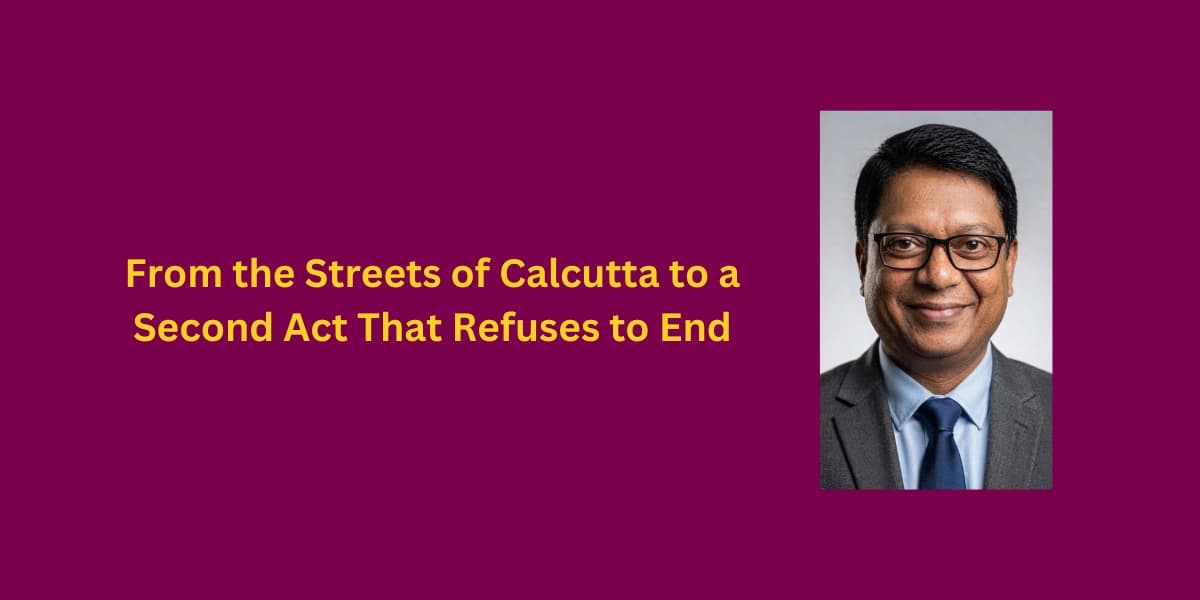
At the Pashupatinath temple in Kathmandu, Umashankar Mukherjee did everything a devout man is supposed to do. He attended the Rudrabhishek. He meditated. He chanted mantras. He was the company’s country head for Nepal, a man who had spent his life making things happen.
None of it quieted what was going on inside him.
Retirement was approaching, and he had no idea who he would be on the other side of it. “I was terribly disturbed,” he says. “What will I do next? I could not console myself.” For decades he had lived at full speed. He could see exactly what was waiting: “a loss of identity, loss of income and everything.”
He is 71 now. Since last September he has written three books. He spends his mornings researching and writing for LinkedIn. Next month he is due to fly to Nepal again for a client. The man who dreaded having nothing to do has, as he puts it, never been idle.
What he stood to lose
To understand why retirement frightened him, you have to understand what he would be retiring from.
Umashankar grew up in Jamshedpur, travelling back and forth to Kolkata, about 250 kilometres away. His mother taught in Jamshedpur and his father was a professor of English at Calcutta University. His mother had a clear plan for him: a job at Tata Steel. So he became a trade apprentice. For four years he trained by morning and went to evening classes for his graduation. He finished college in 1976 and his technical training in 1977.
The plan didn’t hold. His first job was in sales in Calcutta, and something about that life stuck. When he later took a job drawing on his technical training, he lasted about a year and a half. He wanted the other life back. “Sales job, you know, wearing ties and having my car, traveling here and there.”
In 1982 he joined Hindustan Unilever as a territory sales in-charge in Katihar, which he calls a remote place in Bihar. From there his work spread across the whole eastern region. At Gillette, as area sales manager in Kolkata, he helped build the company’s market in the East when it was just establishing itself in India. By his account, he appointed most of its first distributors there. He returned to Hindustan Unilever with a promotion and was put in charge of Wheel across Raipur and Jabalpur. It was the height of the company’s fight with Nirma, a commodity-style battle unlike the way the company usually worked. Later he ran the whole of West Bengal.
Then came Nepal. In 2012 he flew to Barcelona to receive an award from Adi Godrej for his achievement. He met Nepal’s Prime Minister and President, and he represented the Chamber of Commerce. His first book compresses it all into one line he clearly loves: from the streets of Calcutta to the seat of COO.
A life like that is hard to put down.
“I actually got energised”
What he did with his fear is the most distinctive part of his story. He researched his way out of it.
Faith had been with him since childhood; he was initiated by the Ramakrishna Mission at around ten. The spark this time came from his wife, who had trained in Reiki. Reiki, as he explains it, works on the idea that you receive energy from outside and pass it on to heal someone else. He wondered whether he could find his own way to that kind of energy. He wanted it “to heal myself, as also can help others to heal.”
He went looking in the scriptures. He read about Brahma, whom the scriptures describe as the creator of the cosmos and of the four Vedas. If the energy of creation had a source, he reasoned, why not pray toward it? In the Puranas he found a reference to the Brahmarandhra, a point above the head through which spiritual energy is said to enter. From that he built a meditation of his own. In his description, it reaches toward Brahma Loka and draws a cosmic energy through the body’s nadis.
What mattered was the effect it had on him. “I actually got energised,” he says. That was in 2013. From then on, as he puts it, he never went back.
Never idle
Consulting work arrived, and kept arriving. “Whenever I wanted, I got my job, by grace of God,” he says. For years after he formally retired, retirement barely showed up in his life. Until last year he was COO of a Nepali organisation. He came home to Bangalore in September 2025, at 70, shortly before the agitation broke out in Nepal.
Even then he didn’t slow down. He started writing. The first book, Sales Karma Yogi, tells the story of his working life and is out in print, on Kindle and on Google Books. The second, Inner Strength Engineering, turns his meditation practice and its idea of drawing energy from outside yourself into a book. A third has followed.
Asked whether he is actually retired, he answers like a man describing his diary. In July he was in Nepal for a dairy company from Jaipur. Last month he went again. Next month an edible oil company from Nagpur, a ₹2,000-crore business, has engaged him to source edible oil from Nepal. His phone brings business calls from Nepal, Bhutan and India. Some are consulting work and some are people asking for advice, and he answers them all.
His mornings follow a routine. First the puja, then email, then LinkedIn. He is a premium member and a regular contributor, and he researches every topic he writes on. “It takes a lot of time,” he says, and he doesn’t seem to mind.
The leg that bled in Nepal
In 2023 an accident broke his right leg. He needed three operations.
When he travelled to Nepal afterwards, the leg would bleed. He kept travelling anyway, across the whole country. He tells this plainly, without drama. “That kind of physical hindrance never stopped me from working,” he says. He calls it the great challenge of his life and credits the grace of God for getting him through.
It explains how he survived retirement. The anxious man at Pashupatinath was afraid of stopping, and here was his body giving him a good reason to stop. He didn’t.
Nana and Nani to the whole society
Home, too, has changed around him. Umashankar married in 1983. The couple’s only child, a daughter, was born fourteen years later. He moved to Bangalore because of her. She was studying there, and he settled in the city permanently in 2017. “It’s because of my daughter,” he says. Next year will make ten years.
She married three years ago and now lives in Whitefield, about an hour’s drive from his home in Sarjapur. He goes to see her, and sometimes she comes to them. At home it is just him and his wife.
A man who spent most of his working life away from home might have found that quiet difficult. He describes it very differently. They live in a gated community where they have become Nana and Nani, Dada and Dadi, to many of the families around them. “So we never feel alone,” he says. “We are very lucky.”
The city itself was never hard to settle into. Jamshedpur, he says, was so cosmopolitan that almost nobody there was originally from there except the Adivasis. Everyone else had come from somewhere, whether Tamil, Keralite or Telugu. Bangalore felt like more of the same, and in his view it is more cosmopolitan than Mumbai or Calcutta.
Bangalore has also given the old performer in him a stage again. “Every Bengali is a singer,” he says, “so I am also a singer.” In Jamshedpur, with its theatres and big halls, he sang, did stage direction and later acted in TV serials. In Bangalore he organised a Rabindra-Nazrul Sandhya at a resort and styled the grounds like Santiniketan, with song, dance and chanting under the trees. Many of the performers were former Visva-Bharati students now working in IT who had never given up their art.
He now runs a music group and a drama group. He founded Silver Ease Living, a group that meets in English and brings together people of all ages and backgrounds to share ideas. For the Bengali community he runs a Prabeen Nagarik society with some 200 to 250 members.
The fear that once troubled him was about losing his place in the world. In Bangalore he has built several new ones. “I have enough ways to spend my time,” he says, “in the way that I want to live.”
“Nothing extraordinary in me”
Ask him to sum up his life and the anxiety of those temple years is gone from his voice. “I’m fully satisfied,” he says. “Whatever I wanted to do in my life, I have fulfilled. I have no regrets.”
He is more interested in what his story says about other people than about himself. “I believe that everyone can live the life that they want,” he says. “Sky is the limit.” If a salesman from the streets of Kolkata could rise to lead an organisation and sit across the table from a country’s leaders, he says, “it is nothing that extraordinary in me.” What made the difference, he believes, is something anyone can develop: inner strength.
He thinks much of that strength stays hidden. “Rishis and munis and other people in our country, they never advertise themselves,” he says. The talent and energy are there, underneath, for anyone who wants to explore them.
He knows about exploring. A little over a decade ago he stood in a temple in Kathmandu and asked what would become of him. Next month he goes back to Nepal as a consultant, on a leg that has been through three operations