
Thursday, 23 July 2026
Hobbies After 50 That Make Life More Active, Social and Interesting

Ask most people over 50 what their hobbies are and watch what happens. There's usually a pause. Sometimes a slightly uncomfortable laugh. Then something like "I used to paint" or "I played cricket until my knee gave up" or "I keep meaning to get back into reading properly." Past tense. Interrupted tense. The language of things that got set aside somewhere in the busy middle of life, and the quiet assumption, never quite stated, that hobbies after 50 are something you get around to eventually, rather than something worth choosing now.
It's not that people stopped enjoying things. It's that enjoyment stopped being a scheduling priority. For twenty or thirty years, the calendar belonged to work, family, obligations, and the kind of social life that organised itself around other people's needs. Personal interests survived in the margins — a book on the nightstand that moved slowly, a weekend pursuit that got cancelled more often than it happened. And then the margins closed, and the hobbies went quiet.
After 50, the margins open up again. Sometimes dramatically. The question is what to do with them and, more specifically, how to reconnect with the idea of doing something purely because you enjoy it, when that's been a foreign concept for the better part of two decades.
Why Hobbies After 50 Matter
Why Hobbies After 50 Matter
There's a version of this conversation that focuses on the health benefits of hobbies, be it cognitive engagement, stress reduction, a sense of purpose. All of that is probably true. But it's also a slightly joyless way to think about picking up a guitar or learning to make pasta from scratch. You don't need a healthy justification for wanting to enjoy your time.
The more honest case for hobbies after 50 is simpler: they make the week feel like yours. Not the week you managed, or the week you got through, but the week you actually chose. There's a particular satisfaction in spending a few hours on something you're genuinely interested in, something that asks you to pay attention, to improve, to show up with some intention. That satisfaction is hard to replicate through passive leisure. Scrolling is fine. Watching something is fine. But it doesn't leave the same residue.
Hobbies also tend to solve the social problem without you noticing. You show up for the thing like the clay, the chord, the recipe you keep botching, and somewhere along the way there's a person beside you who's also just showing up for the thing. You didn't go to make friends. But six months later there's someone you'd actually call. That's a different quality of connection than anything you'd find by trying to engineer it, and it arrives precisely because neither of you was looking.
The real challenge is not always time
Time isn't the obstacle most people think it is. After 50, especially post-retirement or once the household has quietened down, there are often more unscheduled hours than people know what to do with.
The actual obstacle is subtler. After decades of being productive, useful, needed,having your time mean something to someone else, and suddenly doing something purely for your own pleasure can feel almost illicit. Like you should be doing something more worthwhile with that Saturday morning. The guilt isn't loud. It just sits there, making you feel slightly ridiculous for caring whether your brushstrokes look right, or whether you've finally understood how the opening works in chess.
There's also the quieter problem of not being sure what you actually enjoy anymore. Most people's sense of their own tastes was formed in their twenties and then frozen there, preserved under thirty years of busyness. They never had the time to notice whether the things they once loved still fit, or whether they'd grown into someone with completely different instincts. Finding out requires trying things without any guarantee they'll stick, which is its own uncomfortable skill to relearn.
The right setting makes it easier
A hobby taken up entirely in private like the book you read alone, the language app on your phone, the exercise routine in the spare room is better than nothing. But it has a way of fading. There's nobody to notice if you stop. No shared investment in whether it continues. The friction of starting again after a gap is borne entirely by you.
Hobby groups, classes, and community experiences work better for most people, not because accountability matters, but because the social dimension makes the whole thing more enjoyable. You're not just doing the hobby. You're doing it with people who are also doing it, which changes the quality of the experience considerably.
The conversation that happens around a board game is different from the one at a dinner party. The companionship in a walking group is different from a walk you do alone. The enthusiasm in a cooking workshop when something works, or spectacularly doesn't is different from cooking by yourself. The setting isn't incidental. It's part of what makes the hobby worth sustaining.
This is what the Marzi calendar is built around. The Marzi Run Club meets at Sankey Tank on Sunday mornings at 6:30am, early enough that the city hasn't quite started yet, with a group of people who chose to show up anyway. The Badminton sessions at Play Zone in Sahakar Nagar run on Tuesday evenings. Marzi Evenings: Flashback is a live retro music evening at Nandi Citadel on Sunday at 5pm. These aren't organised in the hope that people will network or self-improve. They're organised around the straightforward idea that doing something is more enjoyable when other people are doing it with you — and that the right setting is often the difference between a hobby that sticks and one that quietly disappears.
Practical Ways to Start With Hobbies After 50
Start with something low-pressure
The worst way to restart a hobby after 50 is to treat it like a project with objectives. The photography course with weekly assignments. The language class where you're assessed. The creative writing group that workshops your work in the first session. These formats carry just enough performance pressure to make showing up feel slightly daunting — which is the last thing you want when you're trying to remember that this is supposed to be enjoyable.
A better entry point asks nothing of you except presence.
● A food walk where the only requirements are an appetite and reasonable footwear
● A game evening where the point is to play, not to win
● A beginner workshop where everyone is equally new and there's nothing to prove
These formats let you experience the pleasure of the thing before any self-consciousness has time to build. One good afternoon is usually enough to start a new relationship. Once you've had it, the next thing is easier to say yes to.
At Marzi: The Coffee Meet-ups at Roastea in Koramangala and the Karaoke Nights are good first moves — sociable, undemanding, and easy to show up to without any prior commitment.
Choose activities that create repeat contact
A one-off experience is enjoyable. But hobbies develop through repetition, through showing up to the same thing more than once and watching it deepen.
● The group that meets monthly becomes the group where you know everyone's name and something about how they see the world
● The series across four weekends becomes the thing you look forward to mid-week because the weekend is coming
● The fortnightly game night becomes a fixture and the kind of plan that doesn't get cancelled because everyone's too invested in it
Repeat contact also builds friendships that single events don't. By the third time you're in a room with the same people doing the same thing, the social arithmetic has changed. You're not meeting strangers anymore. You're just showing up to something you already belong to.
At Marzi: The Run Club at Sankey Tank every Sunday morning and the Badminton sessions at Play Zone in Sahakar Nagar every Tuesday evening are both built for this — same people, same time, accumulating familiarity.
Match the activity to what already interests you
There's no universally right hobby. But some formats work particularly well after 50 — not because they're age-appropriate in the cautious sense, but because they combine genuine interest with a social dynamic that makes them sustainable.
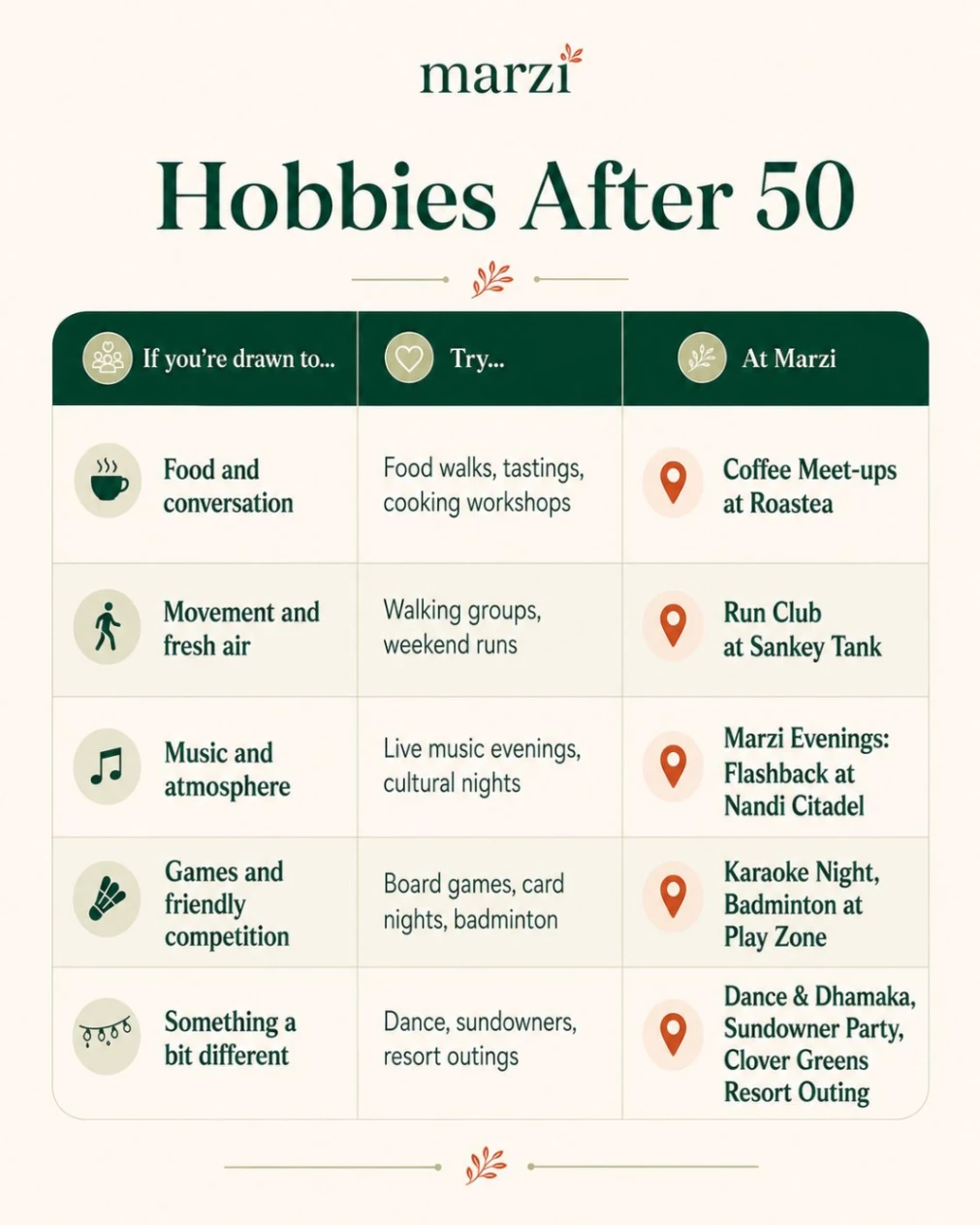
The best starting point is whatever you find yourself thinking about with something resembling enthusiasm. Start there, even if you're not sure it'll last. The ones that last are usually the ones that surprised you.
What to Avoid
A few patterns that tend to get in the way:
Choosing for the wrong reasons. The watercolour class because it seems like something a person of your taste should enjoy. The meditation course because you read it's good for you. The golf membership because it came with the retirement script. Choices made with the head rather than the gut tend to produce dutiful attendance rather than genuine enjoyment.
Over-committing early. Signing up for four new things in the first month feels like starting. It isn't. Too many options mean nothing gets the repetition it needs to develop. Pick one or two, give them a real chance, then decide whether to add more.
Going solo when community is available. Private hobbies have their place. But if you're also trying to expand your social life after 50, combining the two is considerably more efficient than treating them as separate projects.
Dismissing things too quickly. The first session of almost anything is slightly awkward. You're navigating too many variables to settle into the actual experience. Give things two or three attempts before drawing conclusions. Most hobbies that end up mattering had an unremarkable beginning.
How Marzi Can Help
Start with one event or meetup
Marzi brings together hobby-led and interest-based experiences for active adults after 50 in Bangalore — food walks, game nights, cultural evenings, cooking workshops, creative sessions, and day trips. Small groups, well-organised, and planned well enough that you can arrive without preparation and leave having genuinely enjoyed yourself.
The formats vary, but the common thread is simple: things worth doing, with people who want to be there. Which is a better foundation for a good afternoon than most alternatives.
Two good places to start this week: the Badminton sessions at Play Zone, Sahakar Nagar on Tuesday evenings, or Marzi Evenings: Flashback — live retro music at Nandi Citadel on Sunday at 5pm.
Or find your people
If you're looking for something more regular — a recurring meetup, a group that builds over time rather than one good afternoon — Marzi has that too.
Explore 50+ meetups in Bangalore →
Discover things to do after 50 →
Meet people who want similar things from this chapter
The people who show up to Marzi experiences aren't there because someone suggested it would be good for them. They're there because they actively wanted something more interesting to do with their time, and that self-selection produces a particular kind of room.
Curious people. Engaged people. People who have opinions about food, or photography, or cities, or games, and are interested in the opinions of others. The kind of people you find yourself still talking to in the car park after the event officially ended.
Hobbies after 50 are most valuable when they connect you to people who share your appetite for this chapter. That's what tends to happen here.
Read More