
Thursday, 23 July 2026
How to Make Friends After 50 Without Forcing It

There's something slightly embarrassing about admitting you want to make friends. Not at seven, when it's just what you do. Not at twenty-two, when the social apparatus of college, first jobs, or new cities practically throws people at you. But at 52, 58, or 63, when you genuinely wonder how people meet anyone at this stage of life, it can feel like a confession you weren't quite prepared to make.
Which is odd, because almost everyone at this life stage is quietly asking the same question. The colleague you had lunch with for a decade has retired to another city. The couple you used to see regularly went through something and drifted apart. The friend group that held together through your 40s has dispersed in the quiet, undramatic way that adult friendships often do, not with a falling-out, but with less and less glue holding the meetings together until eventually the meetings stop.
You're not isolated. You're just aware, with a clarity you didn't have before, that the friendships you have and the friendships you want are not entirely the same thing. And that making new ones is harder to engineer as an adult than anyone told you it would be.
The title of this piece says "without forcing it" for a reason. Because the forced version, like showing up to events with the explicit goal of making friends, trying to accelerate intimacy, performing warmth at people in the hope that some of it sticks, almost never works. And the not-forcing version, which turns out to be the only one that works, requires understanding what actually produces friendship rather than just proximity.
Why How to Make Friends After 50 Matters
Friendship at this stage of life is different from the friendships of your 20s and 30s, and it's worth being clear about how. The earlier versions were often built on shared circumstance, as you lived in the same halls, worked in the same open-plan office, had children the same age. The friendship formed because the situation made sustained contact inevitable. You didn't choose each other so much as discover each other through repeated exposure.
After 50, the situation stops doing that work. There's no office. The school run is over. The neighbourhood has turned over. And without the structural glue of shared circumstance, making new friends requires something the earlier version didn't: genuine initiative. You have to actually decide you want to meet people, find the settings where that's possible, and then show up more than once.
That sounds simple. It isn't, quite. Because alongside the practical challenge, there's an emotional one that doesn't get talked about enough.
The real challenge is not always time
By the time you're in your 50s, you've accumulated enough social experience to be genuinely selective. You know the difference between people who add value to your life and those who don't. You've sat through enough tedious dinners and going-nowhere conversations to be protective of your time. And that selectivity can inadvertently make starting feel harder than it should be.
There's also a specific vulnerability in wanting new friends that adults aren't always prepared for. Making a friend requires some openness, showing genuine interest in someone, being a little unguarded, risking that it might not go anywhere. That's fine at 25 when the stakes feel low, and the opportunities are constant. At 55, when you're more self-aware and the opportunities feel more limited, it can feel like more is riding on each attempt.
The result is a particular kind of hesitation. You want to meet people, but you don't want to seem like you're trying. You want connection, but not at the cost of looking needy. You want it to feel natural, which means you're reluctant to do anything that might look effortful, even though almost all good things require some effort at the start.
The real challenge isn't finding time for a social life. It's giving yourself permission to want one, and then finding approaches that don't make the wanting feel uncomfortably visible.
The right setting makes it easier
The specific anxiety of trying to make friends as an adult mostly dissolves when the setting is right. And right means one thing more than anything else: shared focus.
When you're both there to do something — cook, walk, play a game, explore a neighbourhood, learn something — the friendship isn't the goal anymore. It's the by-product. You're not staring at each other across a table trying to be interesting. You're both looking at the same thing, which takes the pressure off entirely. The conversation starts itself. The connection happens sideways, quietly, without anyone having to manufacture it.
This is why the best settings for making friends after 50 aren't social events designed around meeting people. They're experiences designed around doing something, where meeting people happens as a side effect.
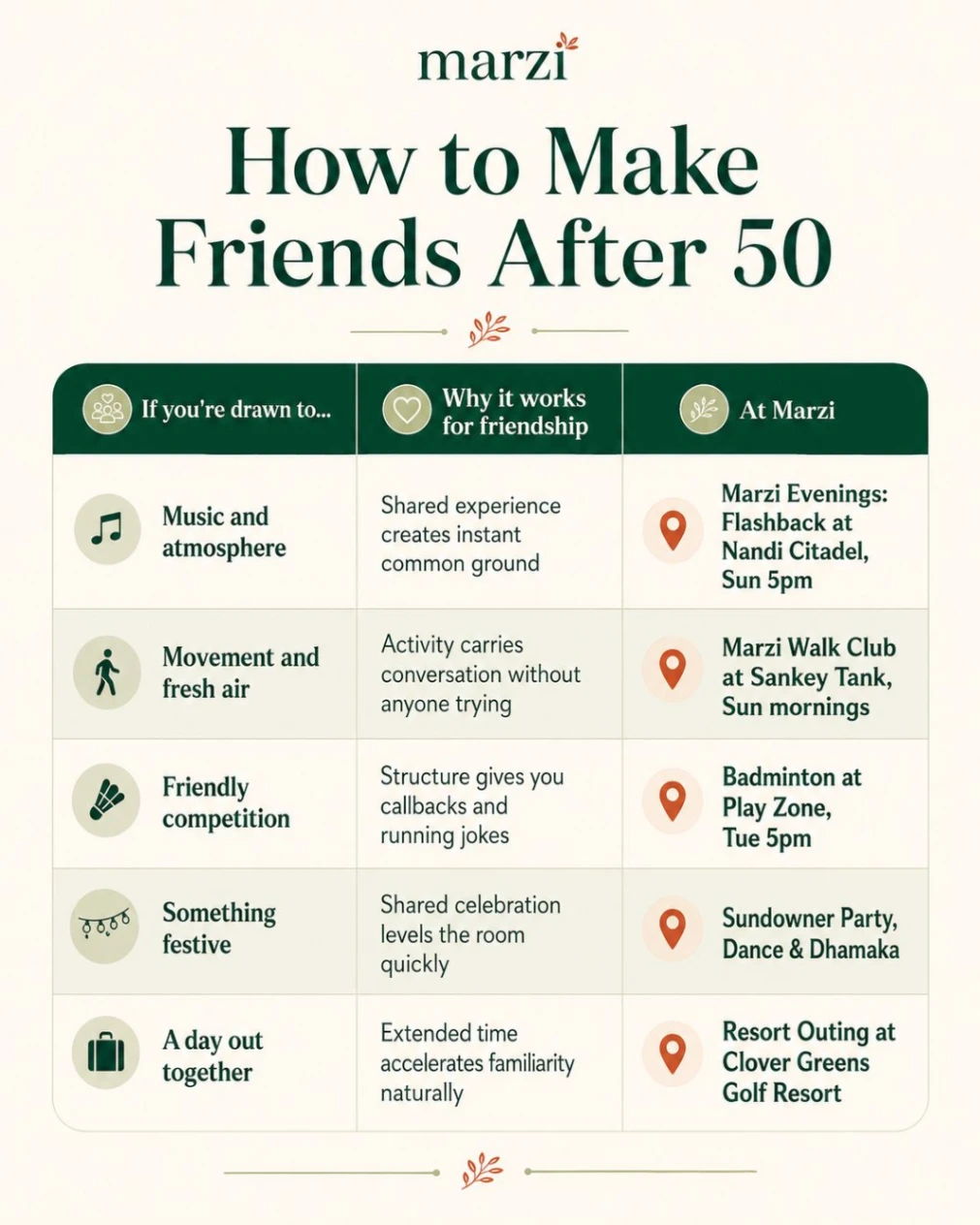
Some settings do this particularly well. The Marzi Walk Club at Sankey Tank works because you're moving together through the same space, which creates a natural ease that a seated conversation rarely has. The Marzi Evenings: Flashback works because live music gives everyone something to be in together — you don't need to perform socially when the room already has energy. The Resort Outing at Clover Greens works because a full day out — golf clinic, pool, meals together — gives you the extended time that accelerates familiarity faster than any two-hour event could.
In each case the shared focus does the work. The setting isn't incidental. It's the whole point.
Practical Ways to Start With How to Make Friends After 50
Start with something low-pressure
Start with something low-pressure
The worst first step is the one with the highest social stakes — the dinner party where you don't know anyone, the large networking event where you're supposed to work the room, the one-on-one coffee with ninety minutes stretching ahead and no obvious topic.
These formats put all the weight on conversational chemistry, in a setting that leaves nowhere to hide if it isn't there.
A better first step is a small-group activity where the activity does most of the social work:
● A workshop where everyone's doing the same thing and conversation is incidental
● A group walk where moving and talking happen simultaneously, which somehow makes both easier
● A game night where the structure provides rhythm and the competition provides energy
These formats let you encounter people at their most relaxed — which is where friendships actually start.
Choose activities that create repeat contact
Friendship is almost never the result of a single encounter. Think back to the people you're closest to now and you will realize that almost all of those relationships were built through accumulated contact. The same face, the same setting, week after week, until familiarity became comfort and comfort became genuine affection.
The formats that build this best:
● A recurring weekly meetup — same people, same time, familiarity accumulates without anyone trying
● A workshop series across several sessions — shared progress gives you something to reference and return to
● A fortnightly game evening — the competition gives you callbacks, running jokes, something to pick up from last time
● A Sunday morning walk group — the rhythm of a regular morning is surprisingly easy to build a habit around
By the third or fourth time you're in a room with the same people, the social maths has changed. You're not trying to make a connection anymore. You're just continuing one that's already quietly underway.
Use shared interests as your starting point
The friendships that form around a shared interest have a particular quality that friendships formed through proximity or obligation often lack. You know immediately that you have something real in common. You have an instant topic. And you have a reason to keep showing up that isn't the friendship itself — which paradoxically is what lets the friendship form.
The goal isn't to find friends. It's to find things worth showing up for consistently, in small groups, with people at the same life stage. The friendships form in the background, without anyone particularly noticing — which is exactly how it's supposed to work.
Explore 50+ meetups in Bangalore →
What to Avoid
The version of friend-making after 50 that reliably fails looks like this: going to large one-off events, having perfectly pleasant conversations that never get followed up, wondering why nothing stuck, and concluding that making friends at this age is just hard.
It's not that it's hard. It's that large, one-off events are a structurally poor environment for making friends at any age. The conversations are too short, too context-free, and there's no obvious reason to follow up.
A few other patterns worth naming:
Moving too fast. Treating one good conversation as the foundation for a close friendship before the contact has accumulated. Connections need repetition before they have weight.
Putting everything into one setting. If it doesn't work, you feel you've failed, when really you've just tried one thing once. Spread your attempts across a few different formats.
Waiting for the other person to initiate. You don't want to seem too keen, so you hold back. The problem is that most people in this situation are running the same calculation. Nobody moves first, and nothing happens.
Expecting a one-to-one ratio. Some attempts won't produce anything. You'll go somewhere, meet people, have a pleasant time, and not feel a particular pull toward anyone. That's fine. The ratio of attempts to genuine connections has never been one-to-one. What changes things is going back to that setting or a different one, consistently enough that the odds start to work in your favour.
How Marzi Can Help
Start with one event or meetup
Marzi runs in-person experiences specifically for 50+ adults in Bangalore and right now, there are several worth looking at.
If you want something easy and social to start with, the Coffee Meet-up at Roastea in Koramangala is exactly that — small group, good conversation, no agenda. The Marzi Walk Club at Sankey Tank on Sunday mornings is a gentle guided walk followed by breakfast, the kind of morning that earns its place in the weekly routine. The Badminton sessions at Play Zone in Sahakar Nagar run every Tuesday evening at 5pm — structured, sociable, and easier to make a habit of than most things. And Marzi Evenings: Flashback — live retro music at Nandi Citadel on Sunday evenings — is for when you want something that feels like a proper occasion. For something further afield, the Resort Outing at Clover Greens Golf Course is a fully curated day out — private bus, golf clinic, pool access, meals included.
Several of these are currently filling fast. One event. One morning. See how it goes.
Meet people who want similar things from this chapter
The particular thing about the Marzi community is that everyone in it made an active choice to be there. They're not attending out of obligation or habit. They showed up because they wanted something more from this chapter, more connection, more interesting experiences, more company worth having and decided to do something about it.
That shared intention matters. People who've already decided to invest in their social life after 50 are considerably easier to befriend than those there by accident or circumstance. The openness is higher. The conversations go further. The follow-through actually happens.
You're not the only one looking for this. Most people in the room are. The setting just needs to be the kind that lets it happen.
Read More