
Wednesday, 19 August 2026
Sweet 16, Every Day: The Many Lives of Manjula Guruswamy
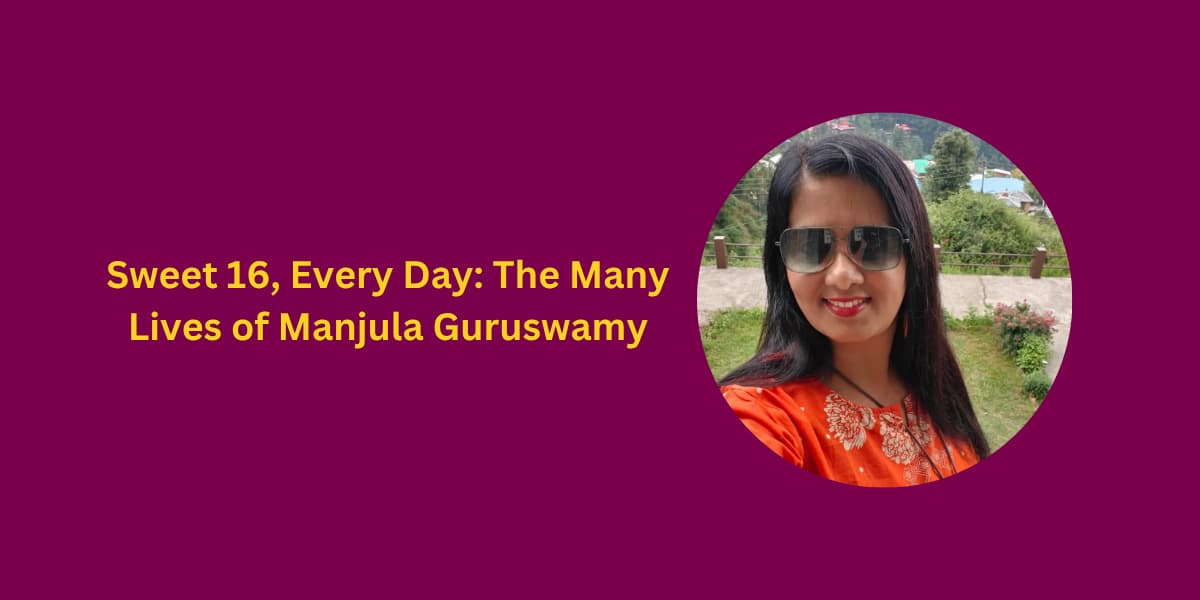
In South Bangalore, most mornings begin the same way for Manjula Guruswamy : badminton at 8:45, a puja she has never once skipped, and then a laptop that opens onto three or four different lives at once - software freelancer, YouTube creator, classical music student, karaoke singer, dancer, occasional anchor, occasional actor. "24 by 7 is not sufficient for me," she says, half-laughing, half-serious. "But God has given only 24 hours a day."
Manjula is 50 plus, she waves the number away like a fly, and she describes herself, without a trace of irony, as "Sweet 16." Not because she is chasing her youth, but because she has decided that age is a story you tell yourself.
Childhood Among the Wires
Manjula's story begins, fittingly, with electricity. Her father was an engineer with the old Karnataka Electricity Board, stationed at a current-receiving substation, and her earliest memories are of playing near the transformers where "a very huge current flow" hummed through the air. The neighbourhood children teased her for it, they called her "current," as if she'd absorbed something from those wires. Looking at the life she has built since, the nickname feels less like a joke and more like a prophecy. She has never stopped moving.
She finished her engineering degree at SIT Tumkur, married a scientist with India's Defence Research and Development Organisation, and settled into life first in Hyderabad, then Bangalore, where she worked as a lecturer at PES Institute of Technology. Three years into her marriage, still without a child, she made a decision that would define the rest of her life: rather than wait, she would pursue her M.Tech.
Studying Through Motherhood
What followed reads less like a life plan and more like an act of sheer will. Weeks into her second semester, Manjula found out she was pregnant. Then came a medical complication that confined her to bed rest for three to four months, meals brought to her, unable to even get up without help, while her coursework piled up untouched. When her doctor finally cleared her, she had one month left before exams and nothing prepared.
She borrowed her classmates' notes. She studied until three in the morning and woke again at six. She sat with her enormous, late-pregnancy belly and balanced her textbooks on top of it, reading aloud while, as she remembers it, her unborn daughter would kick and turn beneath the pages, as if joining in. She walked into her final exams heavily pregnant, and she passed with 75 percent.
It's the kind of detail a lesser storyteller would treat as trivia. Manjula treats it as destiny. Her daughter, born three months before Manjula finished her degree, went on to break a 20-year-old academic record at her school, top her ICSE boards, earn a place at IIT Kharagpur, and land a job at Google. Manjula doesn't claim credit exactly, but she doesn't entirely rule it out, either. "What we do during pregnancy affects our kids," she says, only half-joking about ancient stories of expectant mothers shaping the children they carry. With her second daughter, conceived a few years later, she made a different choice, she left her job, stayed home, watched television, argued cheerfully with everyone in the house. That daughter grew up to be, in Manjula's fond description, "a rebel”, outgoing where her sister is studious, unafraid where her sister is careful. Two pregnancies, two entirely different atmospheres, two entirely different women.
After her first child, Manjula joined back PESIT ( Engineering college ) as Asst Professor. Later she worked with Alliance Business Academy and ICFAI ( Management colleges ). She then shifted to software industry as Test Lead for 10 plus years, in various MNC’s like Relq, HP, Emids, HCL and Verifone. However, 2 years back she quit her 9 to 6 job, since Covid’s work from home policy, increased the expectations to work 24/7. One had to be available to work anytime. So she took up freelancing and along side fulfilled her passions.
The Second Act
Somewhere along the way, after Covid confined the world indoors and Manjula discovered she could sing, she found Marzi. She auditioned for a singing competition on a whim, got pulled into the platform's inner circle, started co-hosting meetups, picked up badminton, tried her hand at dance. What she noticed, watching women twice removed from their working years take the floor, was something she now considers close to a mission: people, she says, spend a lifetime believing that once the earning stops, the living should too.
Manjula disagrees, loudly and cheerfully. She runs two YouTube channels, Mahaguru Melodies, where she strips vocals from popular songs to create karaoke tracks for other singers, and Travel with Manjula Guru, a smaller, budding channel of her own shot-and-edited travel films. She studies classical music formally, the kind of discipline where "ma'am will scold" if the notes aren't practiced. Last year, she took a full month-long solo trip through Himachal Pradesh, ignoring the relatives who worried about a woman traveling alone. "I'm not going to find myself," she told her husband as she left. "I'm going so that you find yourself."
It's a line that captures her particular brand of philosophy: warm, funny, and completely unsentimental about the unpaid decades women spend disappearing into other people's needs. Retirement, she believes, is a government policy, not a biological fact, and certainly not a verdict on a person's worth.
A Life, Framed by Herself
Asked to define life in her own words, Manjula doesn't hesitate: it is not something that happens to you, but something you frame yourself. No one else can carry your suffering, she says, and no one else should be allowed to carry your joy either, the shaping of a life, in sickness and in triumph, belongs to the person living it, "I have not given its control to anyone."
It's a fitting closing note for a woman who studied for an engineering exam with a baby kicking against her ribs, who quit and returned to work on her own three-year rhythms, who boarded a bus alone into the Himalayas at fifty-something because the desire had simply never left her. Manjula Guruswamy's life is not a single, tidy accomplishment. It is a long, ongoing act of refusing to be finished.