
Tuesday, 11 August 2026
The Gift of Time: Life Story of Vipin Gupta
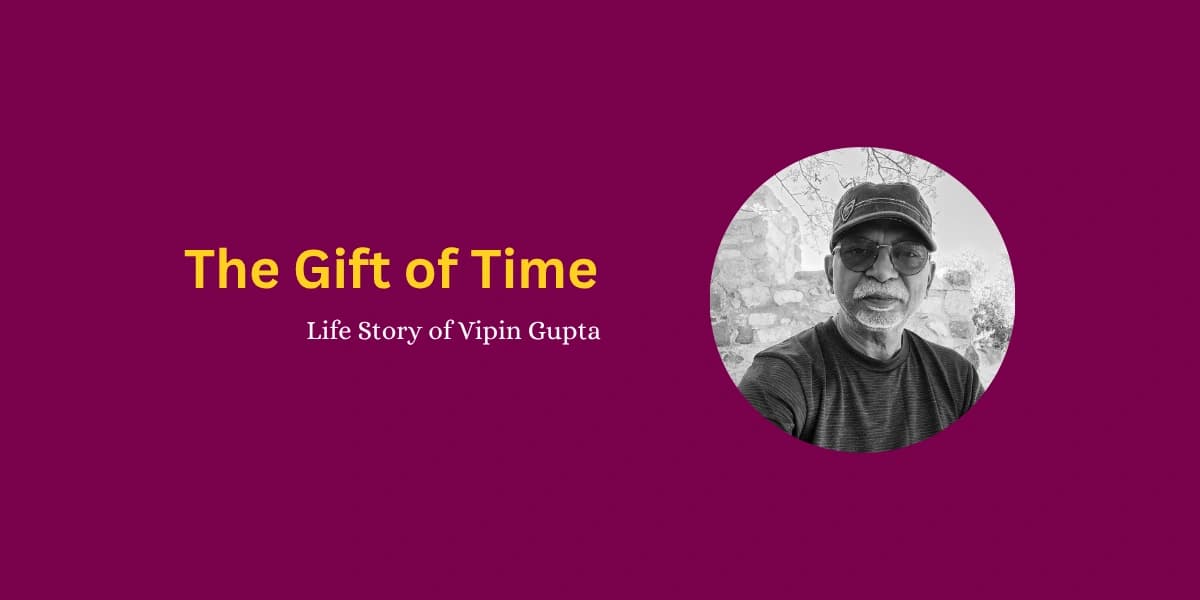
There is a particular kind of quiet that falls in a meditation hall at 9 p.m., when the day's last session ends and nothing is allowed to fill the hours until sleep: no book, no phone, no light switch flipped in either direction that matters. Vipin Gupta remembers sitting in that quiet during a ten-day Vipassana retreat, on a bed he says was harder than the floor, and watching his own mind do something he hadn't expected. It opened like a book. Memories he hadn't visited in twenty years came back to him, page after page.
He hadn't gone looking for stillness. He went, by his own account, "mostly as a challenge", to see whether he could do it. That instinct, to test himself against something simply because it was there, runs through Vipin's life like a thread pulled from childhood to retirement.
A childhood, sweetly given
Vipin was born in 1962, and for the first five years of school he did not live with his parents. He had lived in Jagadhri, near Ambala, with his maternal grandparents. He calls it one of the sweetest stretches of his life.
There were no mobile phones then, no television. There were street games, festivals that broke up the ordinary rhythm of the year, cousins his own age nearby, and grandparents who, as he puts it, are always more forgiving than parents. Even so, a child measures his life against the ones he imagines are better, and Vipin spent those years quietly convinced that his siblings, growing up under their own parents' roof, had the better deal.
When he rejoined his family after fifth grade, the ground shifted. He had studied entirely in Hindi; his siblings were in English-medium schools. Then his father was transferred to Baroda, and Vipin, the eldest son, expected to lead, was enrolled in a school that was purely English, a language he was still learning letter by letter. He remembers the insecurity of those years plainly, the inferiority complex, the instinct to disappear into a crowd rather than be seen struggling. But he did not disappear. He survived it. And then, just as plainly, he describes what happened next, he passed his tenth-grade exams with first division. It was a small victory by any outside measure. To him, it was proof of something larger: that he had resilience, that he could face down things that looked formidable and come through.
Building an ordinary, extraordinary life
After Baroda, Vipin trained as a reservoir engineer and joined ONGC, India's national oil and gas company, the start of a career that would carry him and his family across five or seven cities over the following decades. He married in 1990. He and his wife raised two daughters, both of whom became doctors and now live in Canada. When people ask him to sum up his life story, “it's no different from millions of life stories," he says, the small-town boy who studies, works, and slowly watches his life transform. He would rather talk about what those years taught him.
Retirement, when it came, what he noticed instead was the arithmetic of time changing: hours that used to be squeezed now had room to breathe. He reads more, writes a couple of pages most mornings, reflections on a book, a film, sometimes just the day ahead, and walks twice daily. He is currently enrolled in a course on Urdu and Ghazal appreciation, chasing a form of poetry he says lives quietly inside everyday Hindi without most people noticing. He has trekked to Everest Base Camp and is planning Kilimanjaro next year. And in what may be his most ambitious project yet, he is using AI to build a century-by-century map of world history, not the version taught in classrooms, isolated event by isolated event, but one that traces how a shift in one country rippled into another, decade by decade, back to the start of recorded time. "Time is not a limitation," he says, matter-of-factly. It is, if anything, the one resource retirement finally hands back.
In 2022, after eighteen years abroad, Vipin and his wife moved to Bangalore, a city chosen almost on impulse, where they knew no one. The isolation that followed was real, and honest: without an office or school gate to generate the ordinary friendships of working life, connection had to be built from nothing. It was through a platform for senior professionals that he found his way to Marzi, and to a small, steady sense that there is now a place to go.
Ask Vipin for a philosophy and he reaches, unpretentiously, for the Stoics: you cannot control everything, and you should stop spending yourself on what you cannot. He has had a heart attack, a bypass, and no illusions that his path has been smoother than anyone else's. What he offers instead is a working theory of aging, that the real task of the later decades isn't waiting to be entertained, but building a mind sturdy enough to meet whatever comes next with curiosity rather than dread. As he told his interviewer, quoting a favorite verse he'd once come across: the sense of danger must never entirely disappear, the road is steeper than it looks, and sooner or later, you simply have to take the leap.
He has been taking it, by his own quiet accounting, since he was five years old in his grandparents' house in Jagadhri. He shows no sign of stopping now.