
 Back to Lessons from the Experts


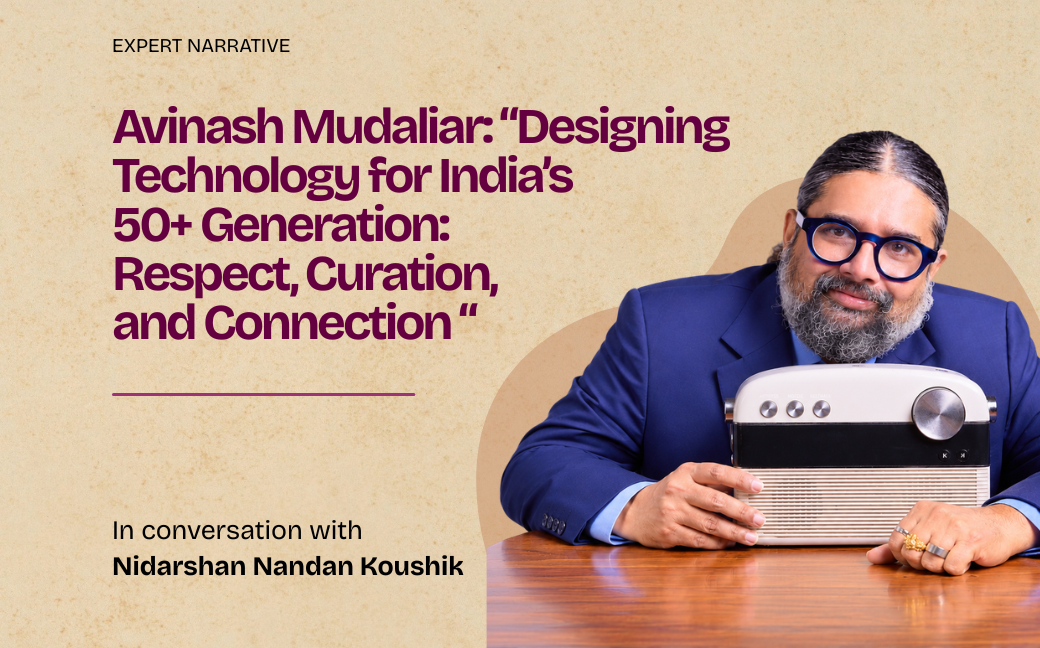
A product builder on how India's 50+ generation actually adopts technology, and what products built for their confidence and taste should look like
Designing Technology for India’s 50+ Generation: Respect, Curation, and Connection
Carvaan proved that a technology product can win over people who never thought of themselves as "tech people", with 4 million units sold. What did you learn about how people over 50 actually adopt technology, and what did most of the industry get wrong about them?
People over 50 don't resist technology. They resist being treated as a problem it has come to fix. My mother taught me this long before any research did.
I co-founded Gaana. It grew to 152 million monthly users. And my mother never heard her bhajans on it. She always preferred a physical device. She was not short of ability, or of love for music. The app simply wasn't where her music lived.
That one observation became Carvaan.
At Saregama, the research said what her habit had whispered: older listeners couldn't find the songs they loved, even though every song sat on every streaming app. The music existed. The access didn't. So, we took away everything standing between a person and a song. No app. No login. No search box. Thousands of songs curated by era and artist, buttons you could feel, Bluetooth and USB for the family that wanted more. When we explained it, the reaction was often two words: "give me one".
The first million units went in under 18 months. At one point Carvaan was contributing close to half of Saregama's music revenue.
Three lessons
1. Adoption follows the job, not the technology. Hearing Rafi at seven in the morning has been a job for fifty years. Serve that job, make the first minute work without help, and adoption is almost instant. The same person who "doesn't do technology" runs four WhatsApp groups. The appetite was never missing.
2. They don't want simple. They want respectful. Carvaan was not dumbed down; it was rich. We removed friction, not content. Older users spot friction first, because they have spent years being told the failure is theirs.
3. The buyer and the user are different people. Carvaan was often a gift, a child buying for a parent. It gave the parent nostalgia and the child the comfort of something modern. I am one of those children. For Dasara I chose to give my mother, who is past 75 and loves silai, a sewing machine. Not an app about silai. A machine she can feel.
What the industry got wrong
It treated age as a disability and designed for decline: bigger fonts, SOS buttons, pill reminders. It should have designed for taste and identity.
In HelpAge India's 2025 survey of 5,798 people across ten cities, 71% of urban elders used a basic phone, only about 40% owned a smartphone and just 13% used the internet or social media. Roughly two-thirds found digital tools too confusing. That is a design gap, not an appetite gap.
Carvaan didn't teach older people technology. It taught technology to behave.
"People over 50 don't resist technology. They resist being treated as a problem it has come to fix."
Our members are accomplished and well-travelled, and many ran large teams. Yet most digital products still treat the 50+ as beginners. Where does that mismatch show up, and what would a product built for their confidence and taste look like?
We measure these users by their device fluency and ignore their life experience.
Picture a retired bank manager who once approved loans worth hundreds of crores, being asked to watch a tutorial on how to tap.
A man I know gave up on a banking app for exactly that reason. The first screen taught him to tap. The product knew his date of birth and nothing else about him.
Where the mismatch shows up
Onboarding that assumes zero knowledge, when the real gap is trust, not intelligence.
"Senior mode": giant buttons that announce how the product sees you.
Content and marketing: stock-photo grandparents, health first, ambition nowhere.
One-way design: built around what these users need, never around what they can give.
Security friction: OTP loops and dark patterns that punish exactly the caution we should reward.
This is not a niche. UNFPA projects that India's 60+ population will grow from 149 million in 2022 to 347 million in 2050, from 10.5% to 20.8% of the country, and that older Indians will outnumber children under 15 from about 2046.
What I have learned building for people who have options. Moneycontrol Pro reached 150,000+ paying users at Network18. Readers pay for depth when you respect their intelligence. OTTplay pulled 30+ streaming platforms and 500+ live TV channels into one place and scaled to 2.5M+ paying subscribers. Curation, not abundance, is what people pay for.
A product built for their confidence and taste
Assume competence, offer help on request. Ask me; don't tell me. No separate "senior" version.
Curation over infinity. Fewer, better choices, picked by people with taste.
A human one call away, in their own language, who can actually fix things.
Contribution as a feature. Let members host, mentor, review and teach. A person who led a team wants a role, not just a feed.
Safety designed in: verified listings, scam warnings in the flow, honest pricing.
Think less "Fisher-Price for grandparents", more "a good members' club with an excellent concierge".
You've built across music, video, food and news, and watched India's content habits change. For someone who now has more time than ever, what are the digital spaces worth their attention, and what is just noise?
Worth your attention is anything that leaves you more connected, more informed or more capable than before you opened it. The rest is noise.
I have spent 25 years watching India's attention change hands. Music with Gaana. News at Network18. Food with Slurrp. Video with OTTplay.
In every one of them, the same thing happened. Abundance stopped being the problem. Curation became the scarce good. Today about 61% of Indian internet users watch short video, an endless stream with no editor in sight.
That taught me that a person with time on their hands doesn't need a bigger feed. They need an editor they trust.
Worth the time
Small, private groups of real people: family, school, college, neighbourhood. One rule: mute the forwards.
Long-form audio and video: music archives, podcasts, lectures, documentaries, regional cinema.
Learning spaces: a language, a craft, a skill postponed for thirty years.
News with a name behind it: an editor, a byline, a correction policy.
Communities of practice: quizzing, cooking, books, photography. Places where people do, not just talk.
Mostly noise
Forwards with no source, especially on health and investing.
Endless feeds built to maximise minutes, not meaning.
Outrage cycles dressed as news.
Anything urgent: "your account will be blocked", "call this number now". Urgency is the scammer's favourite tool.
My mother's bhajans are my favourite test of what is worth attention: a ritual she chose, in a form she trusted, that leaves her calmer than before. The opposite of a feed.
Access is not the issue; 85.5% of Indian households own a smartphone. Comfort and judgement are. And older adults are not simply lonely. Many are looking for stimulation, humour and nostalgia.
A three-question test for any app: Do I know who is behind this? Do I leave better than I arrived? Did I choose to be here, or was I pulled?
"A person with time on their hands doesn't need a bigger feed. They need an editor they trust."
Relocating or an empty nest can quietly shrink someone's social world. From a consumer-behaviour point of view, what do you think makes a digital platform actually bring people together, rather than leaving them scrolling alone?
People are brought together by doing something together, not by being on the same platform.
A move to a new city takes away the conversations nobody scheduled.
The neighbour at the lift. The colleague at the next desk. The chat at the school gate. I call it ambient contact, and nobody notices it until it is gone.
Most platforms try to replace it with profile browsing. That is standing in a room full of strangers. Browsing makes spectators, not friends.
In HelpAge India's 2025 survey, 47% of urban elders named loneliness as the emotion they most associate with ageing. And the Harvard Study of Adult Development found that the quality of close relationships, not their number, was among the strongest predictors of health in later life. It is an observational study, so it predicts rather than proves.
What sociologists and psychologists have long told us
I am a curious student of this, not an expert, but the research is remarkably consistent, and it reads like a design brief.
We befriend the people we keep bumping into. Psychologists call it the propinquity effect: repeated, low-pressure contact builds liking before any real conversation begins. A platform has to engineer the bumping.
Weak ties matter more than we think. Sociologists such as Mark Granovetter showed that acquaintances carry news, ideas and opportunities across circles. After a move or an empty nest, the weak ties vanish first.
Human networks are layered. Robin Dunbar's work suggests a few intimate ties, a supportive circle of around fifteen, and a stable network of roughly 150. This is why small recurring groups work and vast open networks overwhelm.
What actually works
A shared activity, not a shared demographic. "People over 55" is not a reason to meet. A Sunday quiz, a walking group, a recipe swap is.
Small and recurring. Eight to fifteen people, same time every week. Ritual builds familiarity faster than any feature.
Low stakes first. Let people attend without speaking, then invite them in.
Online as scaffolding, offline as the goal. The success moment is a chai in the same city.
Roles over audience. Host, quizmaster, moderator, mentor. Contribution creates belonging.
Design against the feed. If the metric is minutes spent, people end up scrolling alone. Measure people who met someone twice.
I am an enthusiastic amateur quizzer, nothing more. I mostly learn from losing. What keeps me coming back is not the score but the table: shared curiosity, a gentle rivalry and the same familiar faces. I now play quizzes online over Zoom with people I may never meet in person, and even through a screen the habit of turning up at the same time each week creates real familiarity. The bond comes from the ritual, not the app.
A community is a human network, and networks are made of ties, not profiles.
"Browsing makes spectators, not friends. People are brought together by doing something together, not by being on the same platform."
You've spent 25 years anticipating where consumer behaviour is heading. For you, over the next five years, what is the one shift in technology that will matter most to people in their 60s and beyond, and how should they prepare for it?
Technology you talk to, in your own language, that acts on your behalf.
For twenty years, technology asked older people to learn its language. Over the next five, it learns theirs.
Think of my mother again. If she could simply say, in her own language, "play my bhajans", and they played, the app would finally be as easy as her device. She would have no reason to prefer the box.
That, more than any new feature, is what every app like Gaana was missing for her. Voice-first, multilingual AI removes the barrier that was never intelligence. It was the interface.
The groundwork is already laid. One in five Indian internet users uses voice commands, 98% consume content in Indic languages, and 44% have used AI features, led by the under-45s. The people who stand to gain most, people like my mother, are the ones the technology has not yet reached.
At OTT Play, we built an AI discovery stack that delivered 70% faster decisions and 2.3× engagement. We digitised 100+ years of Hindustan Times archives with AI, so that decades of memory became searchable.
Imagine a 70-year-old asking that archive, in Hindi, what the front page said on the day they were born.
The flip side is trust
The same technology makes fraud more convincing. The Supreme Court noted more than ₹3,000 crore lost to "digital arrest" scams, with victims mostly elderly. Even educated, financially savvy people fall for fear, authority, and urgency. When a cloned voice can sound like your son, trust becomes the scarce resource.
How to prepare
Start now, in small ways. Ten minutes a day with one voice assistant: translate a letter, plan a trip, explain a medical report before the doctor's visit.
Treat AI like a bright junior colleague: fast, useful, occasionally confidently wrong. Verify anything touching health, money or law.
Agree a family safe word and a call-back rule. Urgent requests about money or officials? Hang up and call back on a number you already know. A "digital arrest" has no legal standing. Report fraud quickly on 1930.
Guard the money rails: transaction limits and a separate account for everyday UPI.
Widen your world, don't replace it. An assistant that books the class or finds the quiz is a gain. One that stands for people is a risk.
Make it two-way. My 13-year-old already works this way with me: she fixes my prompts, and I check her sources.
Those who show up early will be the ones who set the terms.
"For twenty years, technology asked older people to learn its language. Over the next five, it learns theirs."
Comments (0)