
 Back to Wisdom from our Community


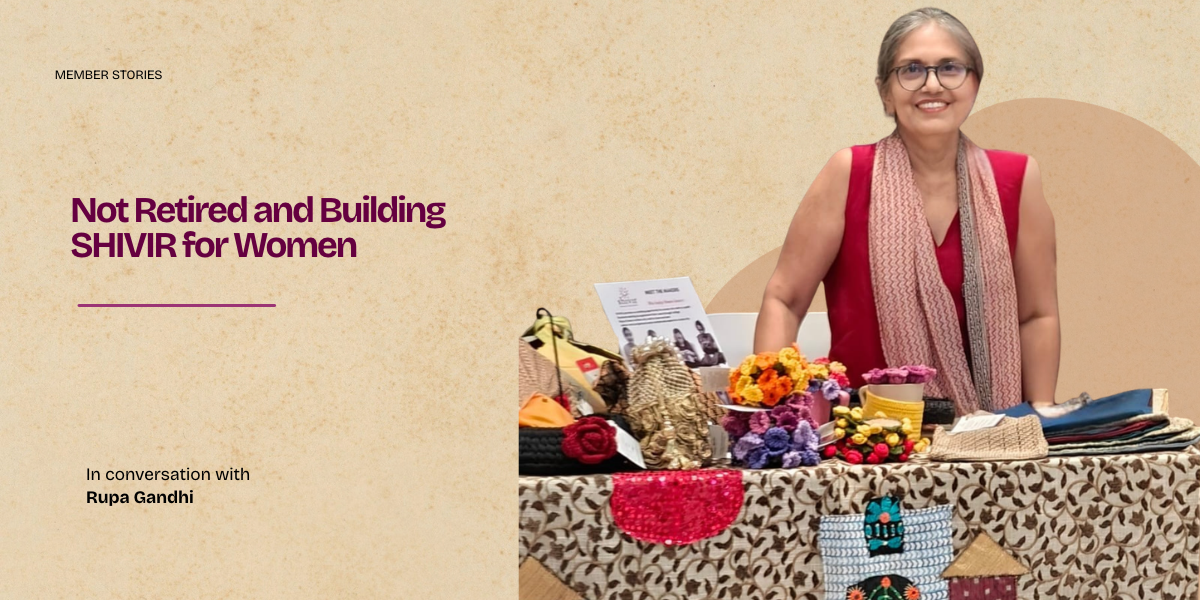
You park the car on the road and walk into the village. Rupa Gandhi will tell you it is smelly and filthy, and she will tell you in the same breath what she plans to do about it: speak to the sarpanch about a cleanup drive. Then she sits down in one woman's house, where three or four others have gathered, hands out the yarn and starts to teach.
The villages lie on the riverbed between Noida and Greater Noida, not far from the society where she has lived for the past two years. Rupa is 64. Until two years ago she was Chief of Marketing at the Wildlife Trust of India, and she does not consider herself retired. "Even after retirement, I'm not retired," she says.
The startup is SHIVIR, a charitable trust she founded with four other women. The name is an acronym, and it stands for Self-help Initiatives for Vocational Inputs and Rehabilitation. The founders, she says, are "all women who have been through a lot in life" and who "dealt with everything on our own steam." Their reasoning was simple: "If we can do it, we can help others do it too."
Park the car on the road
SHIVIR was first registered with five founders in 2007 and then sat idle, because everyone on the founding team was busy with a job. Two trustees dropped out. Now two of them do everything themselves: teaching, visiting homes, packing, forwarding, selling, marketing. A charitable trust has to show at least three years of filed returns to seek external funding, so the three trustees have put in their own money to run it, as Rupa says, "as if it is our own business." All surplus generated, goes back into training and building capacity.
In the last year they have helped more than 20 women who have chosen skill development in sewing and crochet. Only five or six crochet. The others start with thaila and potli bags, stitched from donated dupattas, sarees and bedsheets, because one of SHIVIR's principles is not letting things go to waste. From there they move on to zippered bags, or to quilting. For the crochet group Rupa designs the pieces herself, working from what a high-end household might want to buy. She learned to crochet and sew from her grandmother and her mother, and a hobby that once filled spare hours now carries her working week.
Rupa the Stepney
Rupa was born premature, a blue baby, and with her mother often ill she spent her early years in her maternal grandparents' joint family, twelve people at any time, with a grandmother who had raised seven children and "kept the family together through very challenging times." She names her as her earliest inspiration.
Twenty exciting years at the Wildlife Trust of India made her the person other people leaned on. It began when a family friend, a director there, kept telling her to "come and see what we do." One evening after work she went. Her answer to a vacancy, was a condition: "You protect my pay, and I'll jump." They did. She started in the era of dial-up connections and big desktop monitors, handled the website, the publications and all communications.
Then came the whale shark campaign in Gujarat. She was told it was do-or-die: she could take it on or keep doing what she was doing for the rest of her life. She said yes, and learned what a whale shark was from websites and a pile of clippings and files. The campaign won awards, and she authored two publications about it.
She rose to the executive management team and became the point person for the board of trustees, setting agendas and running their meetings. The organisation's 2020-2030 strategic plan was, in her words, "my own baby." Colleagues began calling her Rupa the Stepney, the spare wheel: "If something doesn't work, you just put her there and she'll make it work." The job took her to annual meetings in Kenya, South Africa, New York and Germany, and across the Northeast of India, where she got to stay with local and tribal communities.
By the end it had become "very, very tiring." They refused to let her go, and she had been making noises about leaving for a while. Her reason wasn't a bad boss. "I'm a Gujarati. I have to have something to call my own, no matter how good the boss is. Very good boss I had."
"Another kind of life began at 40"
She had made that choice once before.
Rupa came to Delhi in 1988 after marrying, with a chemical engineering degree and no chemical engineering jobs to apply for. Her husband worked in media, and through those circles she found work as a sub-editor on an airline's in-flight magazine, where she did travel features and her own photography. When she became pregnant she was put on bed rest. After her son was born she quit and raised him while her husband's media career climbed. He left early and came home late, travelled extensively and there were times, she says, when he saw their son only lying down asleep. "It was a time of growth for us."
When they were both 40, they were driving from Delhi to Ahmedabad and had an accident on the way. Her husband died on the spot. "Another kind of life began at 40," she says. Their son was in his first year at a boarding school at that time.
Within ten days she was applying for jobs. Relatives advised her to take the boy out of boarding school and keep him at home. She refused, because she couldn't work and look after a child alone, and there was no one else. She is an only child, her husband's two elder sisters had settled elsewhere, and there was an old mother-in-law at home. She also had a flat on which the first instalment was already paid. "So I took two tough decisions," she says. She kept the flat and kept her son in school: "I'm not backtracking on this." She had no job and nothing in hand.
The company her husband worked for, offered her a desk job. She turned it down. "I didn't want to be a nobody, where he was a very higher-up somebody. I'd rather go out and choose my own path." She says, she doubts she could make such a decision today: "It would have been a crazy thing to do. With nothing in hand, it was a major risk."
She sat an entrance test that probed her engineering knowledge and landed a job editing scientific journals. The head of her department was, she says, a tyrant, so she kept applying elsewhere. After five rounds she was selected at a reputed IT company and moved within six months. Then they wanted to send her to the US on a project. With a mother-in-law at home and a son in a hostel, she said there was no way. She didn't have a passport, and she didn't get one when they pushed her to. Not long after, she took the friend up on his invitation to visit the Wildlife Trust of India and the rest is history.
A lazy creature
"I'm a lazy creature," Rupa says of her days now. When she had a boss she was at her desk before the office cleaners arrived. Now she wakes leisurely at seven or half past, makes tea and reads the newspaper while she waits for her house help, "my lifeline." Her day, she says, starts technically once the help has gone.
Her left knee gives her trouble. It goes back to a break in her mid-twenties, when she was in her first job: her femur snapped in two, a rod went in, and she was in bed for three months. The knee has turned arthritic. She has joined an orthopaedic surgeon's programme, run on Zoom, with physiotherapy and yoga on alternate days and an app for sessions she misses. It involves strengthening exercises, and it still gets her into the villages and the narrow lanes of Noida's markets where she sources supplies.
Her son is married and lives in Bangalore, where his wife's company relocated; they didn't want Delhi's air. "I live alone here," she says, without elaborating. She has a close group of friends, couples and several single women, whom she calls extended family. They spend coffee time at each other's homes about once a month. Rupa is not into kitty parties and never has been.
She also paints. She had exhibitions in Ahmedabad when she lived there, and now her paintings go out as gifts or are sold to known buyers. Of life in general she says it throws up surprises, "and you just have to take it as it comes, you grab it by the horns. You either ride it, or you get trampled by it."
Paid upfront
What she describes as unusual about SHIVIR is the model they operate on. The women are paid immediately for each piece, whether it has sold or not, and they are paid more than the going rate. Where a maker may be paid 20 rupees for an item elsewhere, SHIVIR pays 50, so that "they remain motivated and don’t get into other, unscrupulous activities." Each product carries a tag with the maker's photograph and a short account of her, so the story travels with the object. The packaging is natural or biodegradable, with no plastic or nylon. Rupa has recently motivated the women to open bank accounts and tells them to put the money toward their daughters' education.
The costs are harder to carry. Tax-exempt donations need 3 years of work on record, and most corporate funding needs a turnover. After a change in trustees the trust had to re-register, and this year was the first year its returns were filed. There are two more years to go. "I've seen a lot of challenges in life, but I find nothing is as challenging as running a charity in today's day and age."
So the sales have to carry it. SHIVIR started with weekend pop-ups at Greenr Café, and last month it had a stall at a festival at Sundar Nursery. Rupa is hoping for an embassy table before Christmas. The marigold toran she designed, which looks like real marigolds, was a Diwali bestseller.
"We don't have any piece left," she says. "And I taught them how to make this."
More power to you Rupa Mam. Love and hugs!
Always knew you have it in you to make a difference. Proud of you, Rupa!
You are not lazy.working & enjoying .great art .didima & vasant bhai were artists.you have inherited every good things from parents.As saumin says Rupa bhagwan.