
 Back to Wisdom from our Community


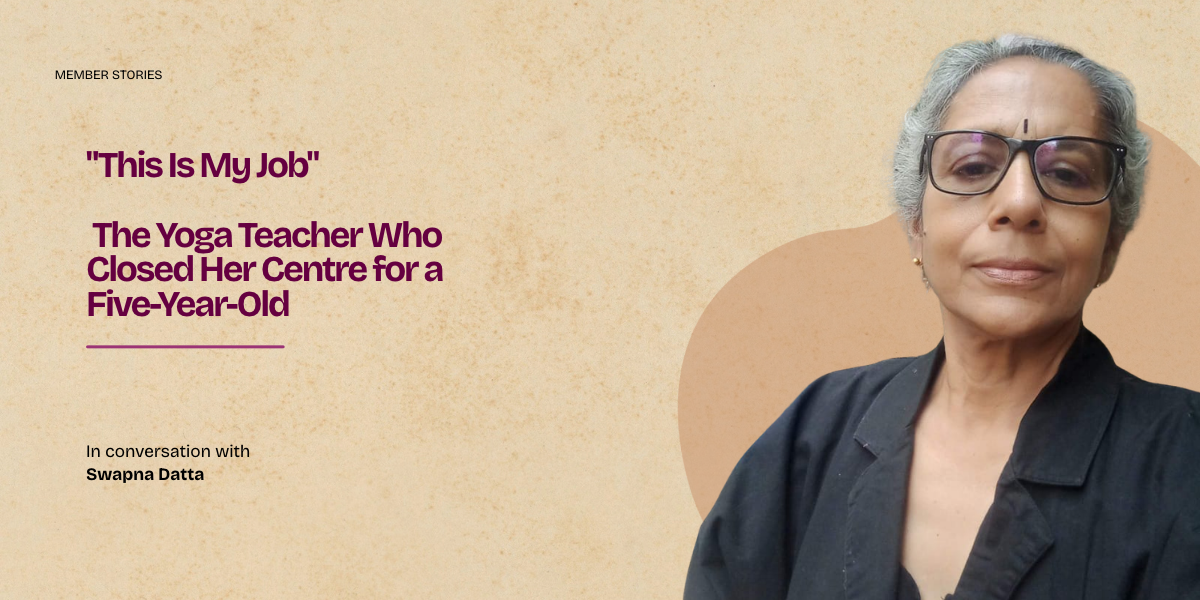
In Calcutta, Swapna Datta came home at nine or ten at night to a house the maids had kept running. In Bangalore, she does all the domestic work herself. She is up between five and half past, and by nine she is leaving the house with her five-year-old grandson for school. She is back at two, and the afternoon and most of the evening belong to him.
She is 65, and she did not plan any of this. "I had never planned to come to Bangalore," she says. She had a life in Calcutta and, for twenty-five years, a yoga centre of her own.
She calls it a job. "I think it is a challenge; this is my job, and I just like that."
"I was a working lady, na"
Swapna was a yoga therapist, and the centre in Calcutta was the work she loved most. "If your profession and your passion are the same, then you are lucky," she says. "And I am lucky." More than fifty people trained there. She had also taught in schools and registered as a yoga therapist with the Ayush ministry. Before the centre had its full hold on her, she had worked in Bangalore in the late nineties as a PRO for colleges, travelling across India for the job. That suited her too, because she has always loved to roam.
Then came Covid. She moved her classes onto her mobile phone and kept going. She says she was not ill herself, but she saw "very pathetic situations" among her neighbours, and she was afraid. "There, I was totally alone," she says. Her only daughter, her son-in-law and her grandchildren were in Bangalore. She came to Bangalore, and she has now stayed for five years.
The centre did not come with her. She shut it down for her grandson's sake, and some of her students, she says, carry on online. "It was very hard for me, but I did."
The work found her again anyway. People she knew from her PRO days in Bangalore heard she was in the city and offered her a job. She was happy about it. Her son-in-law asked her not to take it. She has no financial worries, he said, and the family would support her. She agreed. "Sometimes I feel bad," she says, "I am doing all these things, I am not getting money."
"Chalo, you go ahead"
The flat she lives in now faces her daughter's across the same road. She chose to live separately. The two doors look at each other.
Her daughter's marriage was the first big change in her life, and she describes it as one of the hardest. The daughter fell in love with a Muslim man while studying in Hyderabad. Swapna was brought up in a Hindu household, and she knew what the news would mean for the families on both sides. The daughter asked her many times what she would say. Swapna's only condition was that he be educated.
"You told me, Mama, you love a human being, not a religion," her daughter reminded her. Swapna thought it over and said yes, against her relatives. "Chalo, you go ahead. I am with you." She says it changed her mentally, and she says it plainly: "It's a great change... mentally, I am changed, really."
Her granddaughters now call on their Nani for Diwali. Her son-in-law is a paediatrician. She is happy, she says, "really happy."
The marriage that once stretched her family now pulls her to the next flat. Her daughter left for college and love, and Swapna has moved to wherever her daughter's family lives. She keeps a small flat in Calcutta, locked, and goes back once or twice a year. She finds the culture here different, and she says so. Bengali culture, she adds, is famous all over the world. She doesn't speak Kannada and hasn't needed to. Her granddaughters go to pujas near the lake with her, and to magic shows. "I have no problem at all."
"Nobody can believe it"
Swapna has had more than nine major operations. As a child she was, in her words, handicapped, and there was a time she could not hold a spoon. She sat her master's exam in sociology with her hand in a sling, writing on a table with a pillow below it. She did the degree by distance learning through Annamalai University, with two small children at home. Her children were born by Caesarean.
She did not like yoga as a child. "That time, just didn't like that." It came to her slowly, and by now she is, in her own words, fit. "Nobody can believe it if I don't say that I was physically handicapped totally," she says. "I conquered all these things."
Her body still sets limits. The roads in Bangalore go up and down, and three or four years ago a doctor told her not to walk so much. Half a kilometre on those hills, she says, works the muscles as hard as more than a kilometre on Calcutta's flat ground. She still walks at least five kilometres a day. She talks about this the way she talks about everything physical, as a fact about her and nothing to complain about.
She roamed too. She went from Calcutta to Rameswaram more than seven times and loved the Andaman and Nicobar Islands. She has refused every chance to go abroad. "I like India. First, I just know my own country." She saved money specifically for travel, and still takes trips of two or three months.
"Still, I can feel his smell"
Swapna lost her father when she was a girl at school. It was 23 January, Netaji's birthday, a holiday in West Bengal, with processions in the streets and a function at school. She was home by early afternoon when the news came. "Afternoon, 2 o'clock, 2.30, we came to know that he was no more."
Her first words, she says, were these: "You are a liar, you are a betrayer."
Her father had a doctorate. The family had a factory, which her brothers still run. She was the only girl in the house, loved by everyone, and her mother "handled everything" afterwards. Her grandmother lived with them until she was 85. She died in 1985, after Swapna had married, and Swapna says the house felt different afterwards.
She has accepted other losses. Her mother died in 2007, at what she calls a normal age, and her children were grown. Her father's death she has never settled. "Sudden death is very hard to just adjust to," she says, "Still, I can feel his smell, his talking, his laughing."
She talks about him to her grandchildren. "Do you know my father was like that? Listen."
"This is my job"
Her grandson is a little bit autistic, in her words, and not yet ready for an ordinary school. She and the family noticed when he was about eight months old. His parents are young, the first child was normal, and she says she was "totally blank". She can't say much to them about it, she says, and she doesn't pretend to.
She says her own life changed all over again when he was born. She had planned for her daughter in one city and herself in another, with no hardship in that. After he came, she dropped those plans.
Now her day has a shape. It starts at five. Then comes the morning walk, then the school run at nine, home at two, lunch, and the evening outings with him until about nine. They go by car sometimes. She measures success in her grandson's progress, and she doesn't pretend it's easy.
When the family is away, she goes where she likes, to a friend's house, to the ISKCON temple, to the lake, and once at three in the morning to Nandi Hills. "I spend the day in my own way."
I personally have seen you Aunty what a strong women you are and warm hearted. You speak your heart out. Your life journey and sacrifices for your child and grandchildren always shows your love for the family and is very inspiring. Lots of love and hugs to you Aunty. Stay blessed and be cheerful the way you are.