
 Back to Lessons from the Experts


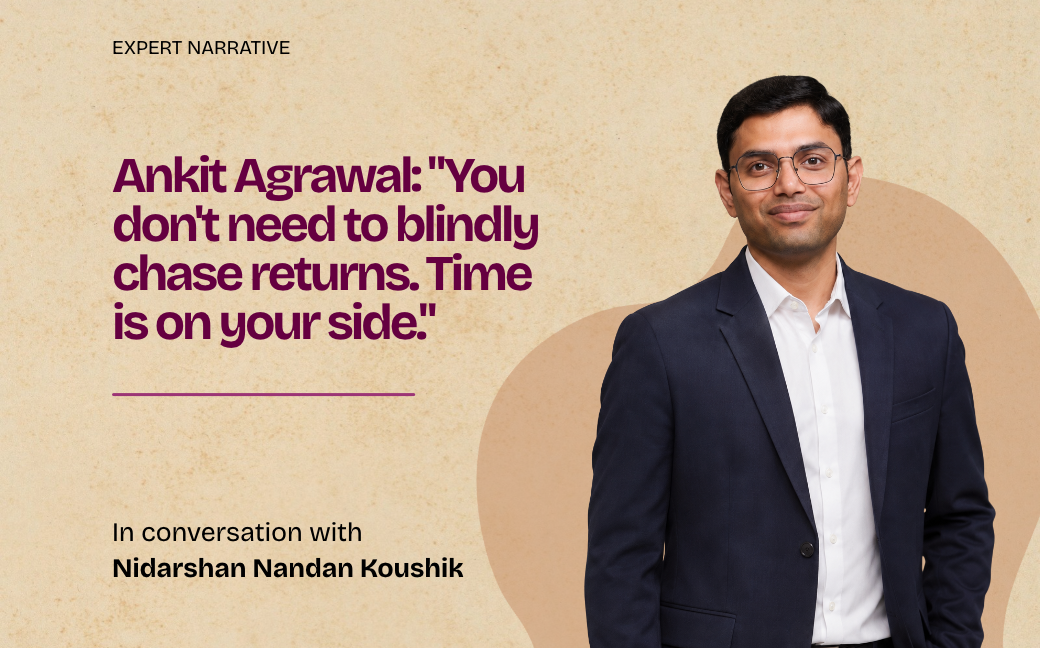
A wealth manager who retired at 29 on what Indians in their 50s consistently get wrong about money
You don't need to blindly chase returns. Time is on your side.
You sit across people who are approaching retirement. Stable income, a house, some savings, but no real plan. What does that conversation actually look like?
The most common problem we see is that money is very fragmented. People themselves don't know where all their money is, or what it is for.
Someone will have fixed deposits in one place, PPF and EPF somewhere else, some stocks on one platform, a mutual fund on another. There is no single dashboard where they can see everything they have. So the first problem is simply: what is the total value of what I own?
The second problem is purpose. Which money is for what? If you are in your 50s, you probably have goals. Your own retirement income once your salary stops, your children's higher education, maybe their wedding. House is usually sorted by then. Car too. But that fixed deposit sitting somewhere, is it earmarked for education, or the wedding, or your own living expenses in 10 years? Most people have no clear answer.
And then there is the inflation question that people completely ignore. If you need 1 lakh rupees a month today, you will need more next year, and more the year after. The same lifestyle costs more every year. So structuring your investments to keep pace with that, inflation-adjusted over 20 or 30 years, is the real task. And most people simply have not been shown how to think about it this way.
"People themselves don't know where all their money is, or what it is for. That is where every conversation has to start."
There is a tendency, especially among people who feel they started investing late, to obsessively chase returns. Is that the right instinct?
Actually, I would push back on that a little. I don't think most people spend their entire career chasing returns. What tends to happen is that people who didn't invest properly in their first 10 to 15 years reach their late 30s or early 40s, feel behind, and then start chasing returns to make up for lost time. And that is when they make expensive mistakes. They get trapped in bad products, because someone sold them something that promised high returns.
If someone had been guided properly from early on, the message would have been simple: time is on your side. You don't need to blindly chase returns. Structure it right, factor in the risk, and let compounding do the work.
The sad part is that a lot of people did understand that saving was important. They started putting money aside. But where that money was going, that is where the guidance was missing.
People in their 50s and 60s have real tax advantages they often don't know about or don't use properly. Is that a knowledge problem or something else?
It is not a lack of information. If anything, it is the opposite. Tax rules in India are genuinely complicated. There are so many clauses and exceptions that even for someone like me, who has spent 15 years in finance and runs a wealth management company, I still don't file my own taxes. I pay a good CA, an expensive one, because he saves me far more than his fee costs, legally.
And that brings up a broader issue in India: people are not comfortable paying for quality advice. If someone is filing income tax returns for 500 rupees, people ask why they should pay 2,000. But you get what you pay for. The CA charging 500 charges that because he cannot justify charging more.
Your CA, your doctor, your lawyer. These are not the places to look for the cheapest option. That cost-cutting is the most expensive decision you can make.
"Your CA, your doctor, your lawyer. These are not the places to cut costs. That decision ends up being the most expensive one you make."
For someone who is 58, 60, just retired, no plan. What are the first moves that actually matter?
I have built a framework we use called SALECOIN. Let me walk through the parts most relevant for someone at this stage.
SA is Savings. What percentage of income is being saved (less critical post-retirement)
L is liquidity. Keep two to three months of expenses accessible in your bank account at all times. Not more, not less.
E is emergency fund. If you are retired with no active income coming in, you should have 12 months of expenses sitting in an emergency fund. Non-negotiable.
C is cover. Health insurance is mandatory at this stage. Not the cheapest policy you can find, but a good one. With what medical treatment costs today, and rising every year, this is not optional. Life insurance becomes less critical once you are retired and your children are grown, but health insurance is the one you cannot skip.
O is obligation. By your late 50s or 60s, you should ideally carry no debt, no loans outstanding. If you do, get that sorted first.
IN is investments. And this is where most people make the biggest mistake. They retire, they stop receiving a salary, and they immediately move everything into fixed deposits and government instruments because it feels safe. But safe and sufficient are two different things. A 6 or 7% return on your entire corpus is not going to let your money grow meaningfully across a 25 or 30 year retirement.
The right approach is to separate your money by time horizon. Whatever you will need in the next 3 to 5 years can sit in safe, liquid instruments. The rest should be diversified, with some equity exposure based on your risk profile. You don't need to take high risk. But zero equity at 60 is also not the answer.
"Safe and sufficient are two different things. A 6% return on your entire corpus is not going to last you 30 years."
Comments (0)